
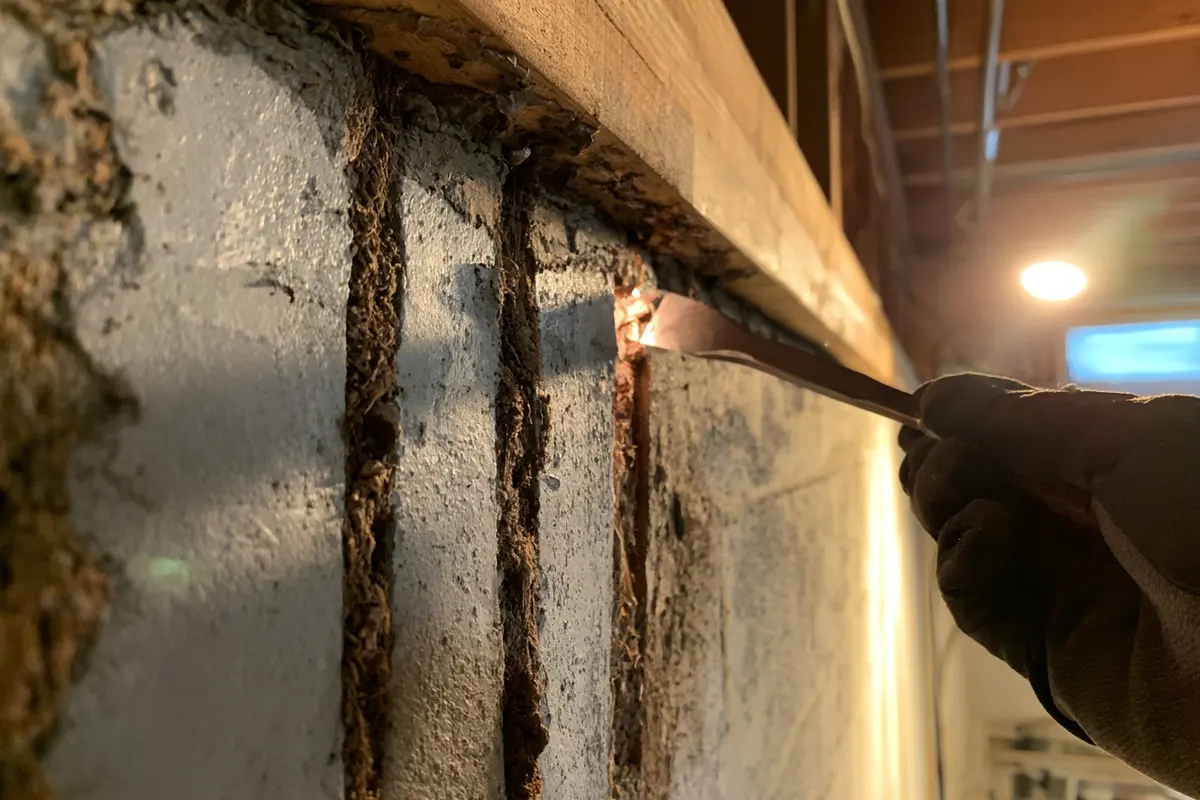
Termite Treatment in Rockford, IL
Get a free quote
A licensed exterminator replies with a price. Nothing is booked until you say yes.
Updated
Short answer
The termite in Illinois that does the damage is the eastern subterranean termite, and it lives underground (University of Illinois). Workers go back and forth between the colony in the soil and the wood in your house, building mud tubes to stay moist along the way (Illinois Extension). You often do not see them. Missouri Extension says a colony takes years before it produces its first swarmers (Missouri Extension), so the first winged termite you notice can come from a colony that has been there a long time. That is why an inspection is worth having before you have a reason to suspect.
Rockford Bug Guys treats termites under an Illinois Department of Public Health (IDPH) structural pest control license, with a certified technician on the job (IDPH). Products are EPA-registered and applied according to the label. If you saw winged insects and are not sure what they were, start with the swarmers vs flying ants guide.
What termite treatment costs in Rockford
These are typical U.S. ranges from national cost guides. They are not Rockford quotes, and liquid termite treatment is priced per linear foot because the number of feet around your foundation sets the total. The quote page takes a description, and the pest control cost page lists the rest of our services.
| Job | Typical cost | Source |
|---|---|---|
| Termite inspection | $75 to $325 per inspection | Angi |
| Inspection, older guide (many companies inspect free) | $0 to $250 | HomeGuide |
| Home-sale WDI clearance letter | $100 to $200 per letter | Angi |
| Liquid soil barrier, exterior | $3 to $20 per linear foot | HomeGuide |
| Bait stations, exterior perimeter | $7 to $12 per linear foot | HomeGuide |
| Bait system, whole home | $1,000 to $2,500 per home | HomeGuide |
| Bait system monitoring | $200 to $400 per year | HomeGuide |
The wide spread on liquid treatment is house size, how much of the foundation is a slab or crawlspace, and whether concrete has to be drilled. We do not print a whole-house liquid total because the guides do not support one, and we price it from a measured foundation. Treatment is separate from repairing damaged wood, which a carpenter prices.
Liquid soil treatment or bait stations
EPA says soil-applied barrier treatment is the most common technique, and the active ingredients include fipronil and imidacloprid, while baits use cellulose bait with a slow-acting insecticide (U.S. EPA). The University of Illinois School IPM page says that once workers are feeding inside a structure, treatment is a soil termiticide around the structure and/or bait (School IPM). The two are not rivals, and some houses get both.
| Liquid soil termiticide | Bait stations | |
|---|---|---|
| How it works | A treated zone in the soil around and under the structure that workers pass through | Stations in the ground that workers feed on, carrying slow-acting bait back to the colony |
| Speed | Fast. Michigan State Extension says liquids work quickly with little upkeep, though they use more chemical | Slow by design. Michigan State says baits can take several months to control an active infestation |
| Upkeep | Little upkeep (Michigan State) | Michigan State says stations are inspected from quarterly to annually depending on the product. One cost guide lists monitoring at $200 to $400 a year |
| Finding the bait | Not applicable | Kentucky Extension says it can be weeks or months before termites find the stations, and a severe case may want a liquid treatment too |
| Fits best | Open foundations, new construction, active infestations | Houses where drilling is hard, or where a soil treatment is not wanted near a well |
| Cost basis | $3 to $20 per linear foot | $7 to $12 per linear foot, or $1,000 to $2,500 per home for a whole home |
Sources: Michigan State Extension, Michigan State, bulletin P2568 and Kentucky Extension. Michigan State describes a liquid treatment as applied by trenching, rodding or drilling to treat the soil around the foundation, and says that on an active infestation baits are often paired with a spot liquid treatment. Kentucky Extension explains why bait is slow: workers carry it back and share it, so the numbers decline gradually instead of all at once.
The honest answer is that it depends on the house. If speed matters, as with a sale deadline, liquid is the faster tool. If drilling is hard or a well is nearby, bait may fit better. We explain which one we would pick and why, and you decide. NPIC, the National Pesticide Information Center, notes that termite nests are hard to find, which is one reason it suggests a professional (NPIC).
Wells, soil and FHA loans: where treatment gets limited
EPA says improper barrier treatments can contaminate the home and nearby drinking water wells, so hire a licensed, trained pest professional (U.S. EPA). If you are outside the city on a private well, tell us before we plan the job. For FHA loans, HUD says HUD says soil poisoning is unacceptable for treating termites unless the lender gets assurance it will not endanger the water supply (HUD Handbook 4000.1). On a house that is being sold with an FHA loan, we check with the lender before we pick a method.
Termite inspection and the home-sale letter
A termite inspection looks at the foundation, sill plates, crawlspace, basement walls, porches and any place where wood meets soil or concrete. We look for mud tubes, damaged wood, shed wings and moisture problems that let termites in. Inspections run $75 to $325 per inspection nationally, and a clearance letter for a sale $100 to $200 per letter.
HUD says that for existing properties the FHA lender must confirm the property is free of wood destroying insects and organisms (HUD Handbook 4000.1). The standard document is the NPMA-33, and HUD's copy shows that the NPMA-33 reflects only the day of inspection and is not a guarantee against hidden or future infestation (NPMA-33). It also asks for the inspection company's pest control business license number and the inspector's license or certification number, which is why you should know who is signing it. The home-sale termite inspection guide walks through what a buyer, a seller and a lender each do, and the license check guide shows how to confirm a company is licensed before you hire it.
Termites in older Rockford houses
The Census puts Rockford's median home at 1965 built, and about 20.1% date from 1939 or earlier, roughly 12,950 homes (Census ACS 2024). Illinois Extension says termites need constant moisture, and describes a house they entered through a gap around a drain pipe (Illinois Extension, 2024). Termites nest in the soil below slabs or basement floors or in soil around the home, and they bring moist mud to seal their tunnels (Illinois Extension). We have no source that gives Winnebago County swarm months or a termite risk zone, so we do not print one. An inspection of your house is the only way to know.
Swarmer or flying ant: how to tell
Winged insects in the house are either termite swarmers or flying ants, and the two need different calls. Three checks separate them, and each one is easiest to see on an insect you have saved in a jar or on tape.
| Look at | Termite swarmer | Flying ant |
|---|---|---|
| Antennae | Straight and beaded (Michigan State Extension) | Elbowed |
| Waist | No pinched waist (University of Maryland Extension) | Narrow, pinched waist |
| Wings | Two pairs, equal in size (Michigan State) | Front and back pairs are not equal |
Sources: Michigan State Extension and Maryland Extension. Swarmers are about 3/8 inch long and mostly appear in early spring, according to Texas Extension guidance (MyTexas Extension), and Missouri Extension says Midwest swarms come on warm sunny days after rain (Missouri Extension). Those are regional notes, not a Rockford calendar.
Termite swarmers: what to do when you see wings
Where you see them matters. Kentucky Extension says swarmers outdoors near a stump do not prove the house is infested, while ones at the foundation or porch do, and Texas guidance says swarmers inside the house point to an active infestation in the structure (Kentucky Extension and MyTexas Extension). Swarmers themselves do not damage wood, and most die indoors from dryness (Maryland Extension).
Illinois Extension says that finding winged termites indoors or outdoors is a red flag that the home should be inspected (Illinois Extension). School IPM adds that swarmers do not bite, carry disease or damage wood, and their arrival calls for a professional inspection (School IPM). Save a few in a jar or a piece of tape and call. The swarmers vs flying ants guide shows the antenna, waist and wing differences. Flying ants are the other possibility, and the carpenter ant treatment page covers those.
If you see swarmers today
| Step | Why |
|---|---|
| Save a few in a jar or on clear tape | Straight antennae and no pinched waist tell termites from ants (Michigan State and Maryland Extension) |
| Note where you found them | Kentucky Extension says ones at the foundation or porch point to the house, and ones by a stump outdoors do not prove it |
| Do not spray them | School IPM says to vacuum them up instead of spraying, since swarmers do not bite or damage wood |
| Look for mud tubes on the foundation | Break one open and see whether termites are alive inside. An empty tube can still mean past activity |
| Call for an inspection | Illinois Extension says finding winged termites is a red flag, and NPIC says nests are hard to find yourself |
Sources: Michigan State Extension, Maryland Extension, Kentucky Extension, School IPM, Illinois Extension and NPIC. Missouri Extension adds that a swarm in the Midwest comes after rain on a warm, sunny day, so a swarm on a spring afternoon is not a surprise (Missouri Extension). It is still a reason to have the house looked at.
Why termite work is not a weekend project
NPIC says termite nests are hard to find, which is why it suggests a professional (NPIC). Michigan State describes liquid treatment as trenching, rodding or drilling the soil around the foundation, and says baits need regular checks for months (Michigan State, bulletin P2568). Neither fits a home-improvement store trip. The part you can do is the part Illinois Extension lists: keep the bare strip at the foundation, watch for mud tubes and keep moisture away from the wall.
What a termite visit looks like
| Step | What happens |
|---|---|
| Inspection | A certified technician checks the foundation, basement, crawlspace and exterior and photographs what we find |
| Report | You get a plain description of what we saw and the method we recommend |
| Treatment | Liquid applied along the foundation or bait stations placed around it, according to the label |
| Follow-up | Bait stations are checked on a schedule. Liquid treatments are re-inspected |
| Moisture notes | We point out leaks, gutters and soil grade that bring moisture against the house |
The bare strip at the foundation, and moisture
Illinois Extension recommends keeping a bare strip of 12 to 18 inches at the foundation, and notes it also lets you see mud tubes on exposed concrete (Illinois Extension, 2024). In practice that means pulling mulch, soil and planting beds back from the wall, and keeping wood from touching the ground. The same Extension piece says termites need constant moisture. Moisture is the one fix a pest company cannot do for you: point downspouts away from the house, fix leaks around pipes and clear gutters. The process page describes how we schedule and what to have ready.
Signs of termites around the house
| What you find | What it can mean | What we do |
|---|---|---|
| Mud tubes on foundation walls, piers or sill plates | Termites traveling between soil and wood. Texas guidance says tubes blend in with soil or concrete | Break one open to see whether live termites are inside. Kentucky Extension says an empty tube can still mean past activity |
| Winged insects or shed wings near a window or door | A swarm indoors or just outside | Identify the insect, then inspect |
| Soft or damaged framing in a crawlspace or basement | Termites, rot or carpenter ants | Tell them apart before choosing a treatment |
Termites and carpenter ants both leave wood damaged, and they need different treatments, so identifying the insect comes first. The carpenter ants vs termites guide shows what each one leaves behind.
What moves the price of termite work
| Factor | Raises the price when | Lowers it when |
|---|---|---|
| Foundation length | A large house with a long perimeter | A small footprint |
| Foundation type | Slab or finished basement walls that need drilling | Open crawlspace or accessible soil |
| Method | Liquid on a long perimeter, or bait with yearly monitoring | A spot treatment where activity is limited |
| Extent of activity | Termites found in several areas | One small area caught early |
| Access | Decks, patios and landscaping against the walls | Open soil along the foundation |
| Reason for the visit | A home-sale deadline that needs a fast schedule | A routine inspection with time to plan |
Ask any company for the method, the linear feet and the follow-up terms in writing, since a quote that skips them cannot be compared with another. If the company is new to you, the license check guide covers the IDPH lookup, the insurance a licensed business has to carry and the December 31 renewal date.
Keeping termites out after treatment
Treatment goes after the colony that was feeding on your house. It does not change the conditions that invited it. Keep the 12 to 18 inch bare strip clear, keep gutters clean and downspouts pointed away from the foundation, keep firewood and lumber off the ground and away from the house, and fix leaks around pipes and windows as soon as you find them. If you have a bait system, keep the stations clear and let us check them on schedule, since Michigan State says baits are inspected quarterly to annually. If you sell, the home-sale letter starts with a fresh inspection, and the home-sale guide explains what the lender will ask for.
We serve Rockford and nearby homes in Loves Park, Rockton, Belvidere and Machesney Park. For ants you find indoors, read ant control, and for the rest of our work see mouse and rat control.
Sources (23)
- Mississippi State Extension, Common Questions About Termites And Termite Control
- University of Maryland Extension, Termites
- Texas A&M AgriLife, Subterranean Termites
- University of Kentucky Entomology, Ef604
- University of Missouri Extension, G7420
- University of Illinois Extension, 2024 07 26 Termite Troubles Three Tips Preventing Infestations
- Mississippi State Extension, P2568 Web
- University of Kentucky Entomology, Ef639
- National Pesticide Information Center, Termite
- HomeGuide, termite treatment cost
- HomeGuide, termite inspection cost
- Angi, termite inspection cost
- U.S. EPA, termites: how to identify and control them
- University of Illinois School IPM, subterranean termites
- University of Illinois, Home, Yard and Garden Pest Newsletter, termites
- University of Illinois Extension, Ask Extension, termite nests and control
- University of Illinois Extension, swarming insects season
- HUD Single Family Housing Policy Handbook 4000.1 (wood destroying insects)
- NPMA-33 Wood Destroying Insect Inspection Report (HUD copy)
- Illinois Department of Public Health, Structural Pest Control
- Illinois Department of Public Health, Structural Pest Control FAQ
- Illinois Structural Pest Control Act (225 ILCS 235)
- U.S. Census Bureau, ACS 2024 1-year, tables B25034 and B25035 (via Census Reporter)
Where this is done
Termite Treatment across Rockford and the cities and villages around it. Each town page covers that town's own housing age, property rules and mosquito program; the full list is on the service area page.
Ready for a price on termite treatment?
Call, text, or send the form. You get a price back before any work is scheduled.
Termite Treatment: questions
How much does termite treatment cost in Rockford?
National guides put a bait system for a whole home at $1,000 to $2,500 per home and a liquid soil barrier at $3 to $20 per linear foot. Those are typical U.S. ranges from HomeGuide, not a Rockford quote. See the pest control cost page.
How much does a termite inspection cost?
Angi puts a termite inspection at $75 to $325 per inspection. Some companies inspect free as part of a sales visit, so ask what is included. See the termite inspection guide for the home-sale version.
Is liquid termite treatment better than bait?
Neither wins every time. EPA says soil-applied barrier treatment is the most common technique, and baits use slow-acting insecticide that workers carry back to the colony. We choose by house, foundation type and whether a well is nearby. See the comparison above.
How fast does termite bait work?
Slowly. Michigan State Extension says baits can take several months to control an active infestation and need regular checks, and Kentucky Extension says it can be weeks or months before termites even find the stations. Liquid treatments act faster but use more chemical.
How do I tell a termite swarmer from a flying ant?
Termite swarmers have straight, beaded antennae and no pinched waist. Flying ants have elbowed antennae and a narrow waist. See the swarmers guide.
Should I keep mulch away from my foundation?
Illinois Extension recommends a bare strip of 12 to 18 inches at the foundation, which also lets you see mud tubes on exposed concrete.
What kind of termite lives in Illinois?
The eastern subterranean termite, which nests underground. Swarmers do not bite or damage wood, and finding them is a reason to call for an inspection. See the swarmers guide.
Do I need a termite letter to sell my house?
HUD says for existing properties the FHA lender must confirm the property is free of wood destroying insects and organisms, and the standard form is the NPMA-33. A clearance letter costs $100 to $200 per letter in one national guide. See the home-sale inspection guide.
Can termite treatment contaminate my well?
EPA says improper barrier treatments can contaminate the home and nearby drinking water wells, so hire a licensed, trained pest professional. Tell us if you are on a well and we plan around it.
How do I know if a termite company is licensed in Illinois?
It is unlawful to run a commercial structural pest control business in Illinois without an IDPH license. Use the IDPH Pest Control Business Search to check. Business licenses expire every year on December 31. See the license check guide.
Does the inspection guarantee no termites?
HUD says the NPMA-33 reflects only the day of inspection and is not a guarantee against hidden or future infestation. A clean report today does not rule out later activity, which is why bait monitoring and regular inspections exist.
Other services
Termite Treatment: get a written price
Tell us the pest, the town and where you are seeing it. A licensed exterminator replies with a price, and no work starts until you agree to it.
Prices and the full service list are on the homepage for a exterminator in Rockford.