
Spider Control in Rockford, IL
Get a free quote
A licensed exterminator replies with a price. Nothing is booked until you say yes.
Illinois has more than 500 kinds of spiders, living in a wide range of habitats (IDPH). Most of the ones that end up in a house are there for the insects. People call us for the ones that look alarming, such as a big hairy spider crossing the basement floor, or for the webs that return a week after you clear them. We treat the spots where the spiders live and travel, and we tell you what is feeding them.
What spider control costs in Rockford
These are typical U.S. ranges from national cost guides, not quotes. A one-time visit handles an active problem. A plan keeps the insects down year-round, which is what keeps spiders from returning. The exterminator cost page covers every pest.
| Job | Typical cost | Source |
|---|---|---|
| Spider control | $100 to $500 | Angi |
| One-time general pest control visit | $108 to $261 per visit | HomeAdvisor |
| Quarterly pest plan, per visit | $100 to $300 per visit | Bob Vila |
| Ongoing pest plan, per year | $300 to $900 per year | HomeGuide |
| General pest inspection | $50 to $200 per inspection | HomeGuide |
The price rises with the size of the house, the number of rooms and outbuildings, and how many webs and egg sacs we find. A basement with a window well on every wall costs more than a slab house. If spiders are the symptom of a bigger bug problem, the plan is the better value, and the quarterly pest control guide compares a plan with a one-time visit.
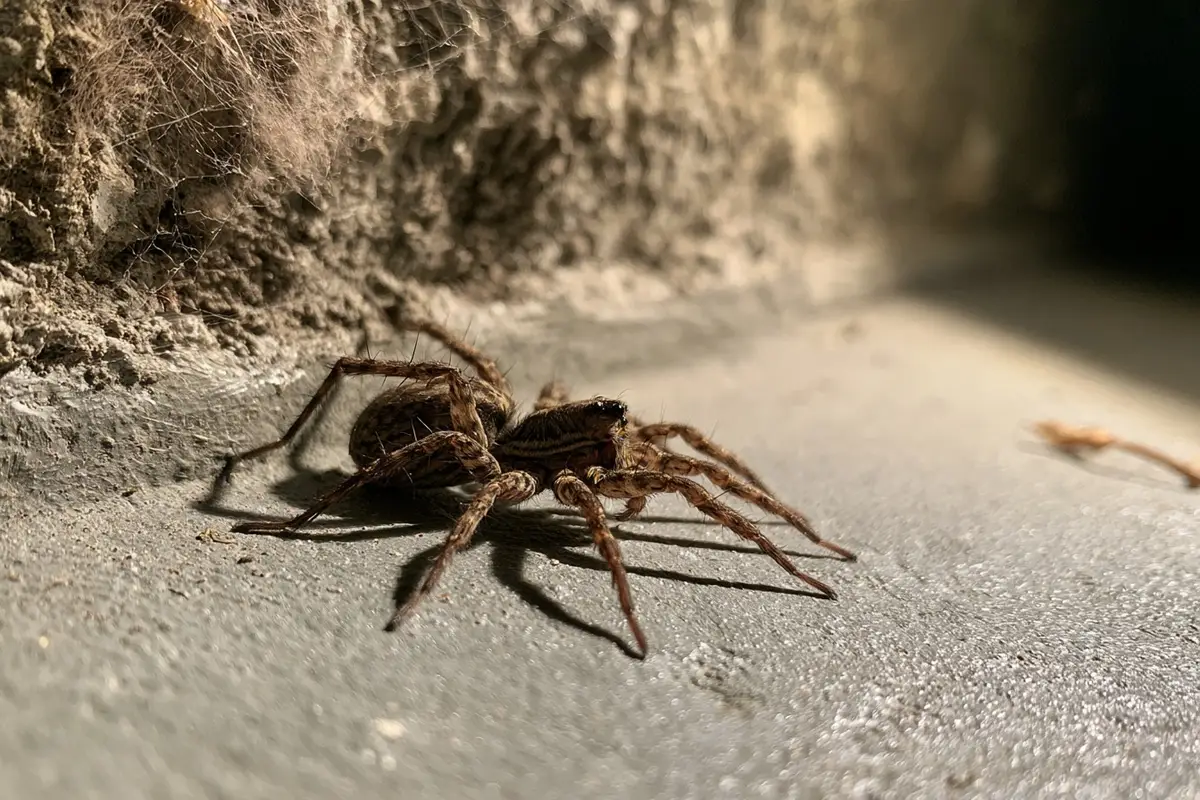
Wolf spiders, cellar spiders and the webs in your basement
| Spider | What it looks like and where | What to know |
|---|---|---|
| Wolf spider | Large, hairy and brown, usually seen on the floor or along walls rather than in a web | IDPH says any large hairy spider in the eastern half of the U.S. is most likely a wolf spider, and its bite is not considered dangerous |
| Cellar spider | Small body, very long thin legs, loose webs in basement and crawl space corners | A web builder, which IDPH says is easier to control than a spider that hunts |
| Funnel web and sac spiders | Spiders that wander in from outside | IDPH says both enter structures in fall |
| Window well and foundation spiders | Webs across window wells, door frames and under siding and soffits | IDPH says outside lighting draws insects, and spiders follow the insects |
Spiders are predators, and IDPH says the first step is to identify whether the spider hunts or builds webs, since web builders are easier to control (IDPH). A basement with a lot of webs usually has a lot of small insects for them to eat. So we do two things at once: deal with the spiders, and look for the insects and the gaps that feed them.
The wolf spider is the one that frightens people because of its size. IDPH says its bite is not considered dangerous. It hunts instead of building a web, so you see it crossing floors and not sitting in a web.
What about brown recluse spiders in Illinois
The Illinois Department of Natural Resources says the brown recluse may be found in the southern two-thirds of Illinois (IDNR). We bring it up because it is the spider people ask about most. We do not tell you what species you have on a guess. If you find a spider you are worried about, take a clear photo, catch it in a jar if you can do so without touching it, and send it to us. IDPH also accepts specimens through its Arthropod Specimen Form. IDPH says brown recluse bites are rare even in infested homes, and that many injuries blamed on them turn out to be something else. A spider bite that looks bad, or that is followed by fever or spreading redness, is a doctor visit, not a pest control call.
How we treat spiders
- Inspect the inside and outside. We check basements, crawl spaces, garages, window wells, eaves and the foundation, and we note egg sacs and the insects they are feeding on.
- Remove webs and egg sacs. IDPH calls vacuuming spiders and webs a non-toxic method. We clear webs and any egg sacs we find by hand and by vacuum.
- Treat cracks, corners and window wells with EPA-registered products applied according to the label, by a certified technician working under an Illinois Department of Public Health license. We treat this as a supporting step, because insecticide sprays usually do little against spiders beyond some repellency (Texas A&M School IPM).
- Treat the foundation perimeter to reduce what wanders in, and note the gaps worth sealing.
- Follow up on the food source. If ants, crickets or other insects are the reason, we say so and treat for them, or point to ant control or the cockroach exterminator page.
When spiders move in, and what a bite means
IDPH says funnel web and sac spiders enter structures in fall, and that outside lighting draws insects and so spiders (IDPH). That makes late summer the time to seal gaps and to look at the lights over doors and garages, before the spiders look for shelter. The University of Illinois Division of Research Safety says bites happen when a spider is pressed against skin, like in a shoe or a stored box (University of Illinois Division of Research Safety), so shaking out shoes and boxes you have not touched in a while is the simplest protection.
For the spiders people worry about, IDPH says brown recluse bites are rare even in infested homes, and that many injuries blamed on them turn out to be something else. The northern black widow is the common widow in northern states like Illinois, IDPH says, so any widow you find is that species (IDPH). We do not tell you what species you have from a description, and a photo or a specimen is the way to find out.
Spiders in window wells and around the foundation
Window wells are the spot we check first on a Rockford basement job. They are open to the weather, they collect leaves, and they hold the damp, shaded air that gnats, crickets and other small insects like. Spiders build across the opening, and some drop through any gap in the frame. A well with a cover and a clean floor has fewer spiders than one packed with leaves. The same goes for the foundation line, where mulch piled against the wall, stacked firewood and overgrown shrubs give spiders a protected place to wait for prey.
We clear the webs by hand and vacuum, treat the well, the frame and the first stretch of foundation wall, and note the gaps worth sealing. The honest limit is that pesticides alone fail unless the habitat is removed and the gaps are sealed, which is Colorado State's advice, and Mississippi State names exclusion and sanitation as the main steps (Colorado State Extension, Mississippi State Extension). If webs are returning week after week, tell us, because that points to the insect source we have not found yet.
Spider control or a pest plan
A one-time spider visit makes sense when you have a clear, local problem, such as a basement that you want cleared before guests come or a garage that is full of webs. A plan makes sense when the spiders come back each season, or when you also see ants, flies, crickets or roaches. A plan keeps the foundation and the entry points treated through the year, so the insect food does not build up. We price both so you can compare them side by side, and the exterminator cost page shows the plan prices. If the main problem is a different pest, the other pages cover it: ants, cockroaches and fall invaders.
What you can do to keep spiders down
- Vacuum webs and egg sacs, and empty the vacuum outside.
- Move stored boxes up off the basement floor and away from walls, and switch to plastic bins with lids.
- Clear leaves and debris out of window wells and away from the foundation.
- Seal gaps around pipes, cables and window frames, and fix door sweeps.
- Cut back outdoor lighting near doors where you can, since IDPH says outside lights draw insects and so spiders.
The spiders in a Rockford basement guide walks through the whole sequence for a damp basement. We serve Loves Park, Machesney Park, Cherry Valley and Rockton as well as Rockford.
Sources (13)
- Illinois Department of Public Health, spiders
- Illinois DNR, Wild About Spiders, brown recluse
- Angi, pest control service cost
- HomeGuide, pest control prices
- HomeAdvisor, hire an insect control service
- Bob Vila, pest control cost
- HomeGuide, exterminator cost
- Illinois Department of Public Health, Structural Pest Control FAQ
- Texas A&M School IPM, Ipm Action Plan For Spiders
- Colorado State Extension, Spiders In The Home
- Mississippi State Extension, P2443 Web
- Illinois Department of Public Health, Brown Recluse Black Widow Spiders
- University of Illinois Division of Research Safety, Arachnids
Where this is done
Spider Control across Rockford and the cities and villages around it. Each town page covers that town's own housing age, property rules and mosquito program; the full list is on the service area page.
Ready for a price on spider control?
Call, text, or send the form. You get a price back before any work is scheduled.
Spider Control: questions
How much does spider control cost?
National guides put spider control at $100 to $500. These are typical U.S. ranges, not a Rockford quote, and a larger home or a heavy infestation costs more. A pest plan is often cheaper over a year than repeat visits. See the cost page.
Why do I have so many spiders in my basement?
Spiders go where the insects are, and IDPH notes that outside lighting draws insects and so spiders. Gaps at the foundation let both in. Colorado State says pesticides alone fail unless you also remove habitat and seal gaps, so cutting down the insects and sealing the foundation lasts longer than spraying.
Are wolf spiders dangerous?
IDPH says any large hairy spider in the eastern half of the United States is most likely a wolf spider, and its bite is not considered dangerous. They are fast, they hunt on the ground and they look worse than they are.
Are there brown recluse spiders in Rockford?
IDNR says the brown recluse may be found in the southern two-thirds of Illinois. We do not guess at a species. If you have a spider you are worried about, send us a photo or a specimen and we will tell you what it is.
What are cellar spiders?
They are small spiders with very long thin legs that hang in loose webs in corners of basements and crawl spaces. They are web builders, which IDPH says are easier to control than hunting spiders. Vacuuming the web and sealing the gap they came through is the place to start.
Why do spiders come back after I clear the webs?
Usually the insects they eat, plus an open gap. Clearing a web only helps if the food and the entry point change too. We vacuum webs and any egg sacs, treat the corners and look at the insect problem underneath.
Do I need a plan for spiders?
Not always. A one-time visit works for a single basement with a visible problem. If the spiders come back every season, or you also have ants, flies or crickets, a quarterly plan keeps the insect food down. The plan guide compares them.
What should I do about a spider bite?
We cannot diagnose a bite. Wash it, watch it, and see a doctor if it spreads, blisters, turns dark, or comes with fever. Bring the spider if you caught it, and call us for the house.
Other services
Spider Control: get a written price
Tell us the pest, the town and where you are seeing it. A licensed exterminator replies with a price, and no work starts until you agree to it.
Prices and the full service list are on the homepage for a exterminator in Rockford.