
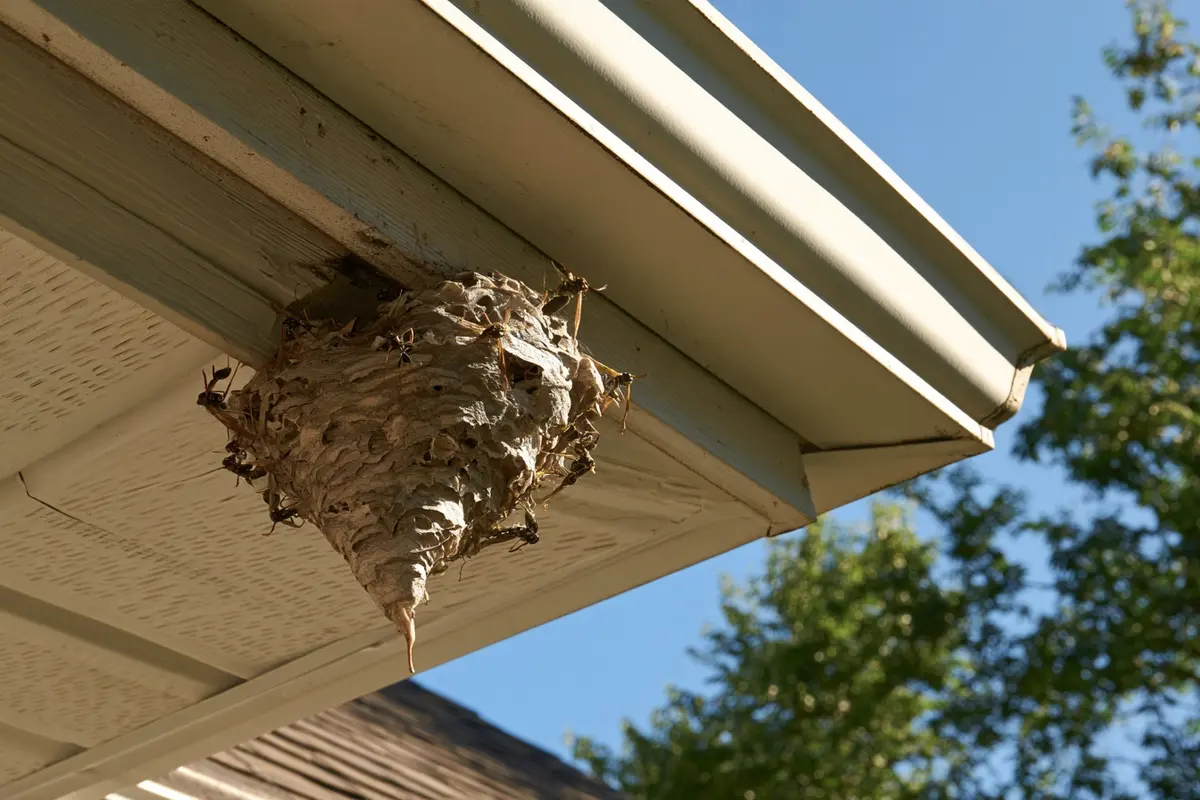
Wasp Nest Removal in Rockford, IL
Get a free quote
A licensed exterminator replies with a price. Nothing is booked until you say yes.
Updated
Short answer
A wasp nest by the front door or under the deck is a sting waiting to happen, and the people who get hurt are usually the ones who tried to knock it down. IDPH reports that 50 to 100 people die each year from bee and wasp stings (IDPH). Most stings are not serious, but anyone with a sting allergy, and anyone with a nest near a door, a play area or a grill, should not take the risk. We treat and remove the nest, and we tell you what kind it was so you know what to watch for next year.
What wasp nest removal costs in Rockford
The price depends on the kind of stinging insect more than on anything else. The numbers below come from national cost guides, so they are typical U.S. ranges and not quotes. The exterminator cost page has the rest of our pests.
| Kind of nest | Typical cost | Source |
|---|---|---|
| Wasp, hornet or yellowjacket nest, overall range | $300 to $700 per nest | HomeGuide |
| Paper wasp nest | $150 to $350 | HomeGuide |
| Hornet nest | $300 to $475 | HomeGuide |
| Bald-faced hornet nest | $500 to $800 | HomeGuide |
| Yellowjacket nest | $600 to $1,200 | HomeGuide |
| Paper wasp nest, second guide | $100 to $200 | Angi |
| Honey bee swarm removal, for reference only | $125 to $200 per swarm | HomeGuide |
A small paper wasp nest under an eave sits at the bottom of that table, and yellowjacket nests sit at the top. Size is part of the reason: Iowa State says a social wasp nest can hold up to 5,000 workers (Iowa State Extension). Where the nest is matters too. A nest at ground level is quicker to reach than one at the peak of a two-story roofline.
Paper wasps, yellowjackets and bald-faced hornets
The three kinds act differently, which is why we ask what you saw before we pick a plan.
| Kind | Where the nest is | What to know |
|---|---|---|
| Paper wasp | Open, umbrella-shaped comb under eaves, railings, porch ceilings and sheds | Usually the easiest nest to remove. Wasps defend it when it is touched |
| Yellowjacket | Abandoned rodent holes in the soil and building voids, cracks and crevices | The nest entrance can be a small hole in the lawn, which is why mowers hit them. Numbers peak in late summer |
| Bald-faced hornet | Illinois Extension describes a large nest, usually in a tree canopy | The colony exists for one season only, and queens overwinter to start new colonies |
The yellowjacket and bald-faced hornet details come from Illinois Extension and the Illinois Department of Natural Resources (Illinois Extension, IDNR). The bald-faced hornet is common and native to Illinois, so seeing one does not mean something unusual is happening. It means a colony started nearby this season.
Ground nests and wall nests
Yellowjackets nest in abandoned rodent holes and runs in the soil, and in building voids, cracks and crevices, which are common on houses. A ground nest shows up as a steady stream of wasps going in and out of one hole in a lawn, a garden bed or a retaining wall. A wall nest shows up as wasps entering at a gap in the siding, a soffit or a crack by a window, sometimes with a buzzing in the wall.
- Do not plug the hole. Iowa State says not to plug a wall opening until the activity has fully stopped (Iowa State Extension).
- Do not mow over a ground nest or try to bury it. Virginia Tech says a ground nest gets a treatment of spray first and then dust, and that it should not be buried (Virginia Tech Extension).
- Mark the spot and keep children and pets away until we treat it. Pointing out the hole from a distance saves time when we arrive.
- Treatment is done at dusk or after dark. Extension sources say to treat at night after the workers have returned to the nest, when most of the wasps are inside and the sting risk is lower (Virginia Tech Extension, NC State Extension, Iowa State Extension). Purdue advises a red-covered flashlight, because white light attracts wasps (Purdue Extension). We use EPA-registered products applied according to the label and tell you how long to stay away from the area.
Why wasps get worse in late summer
IDPH says yellowjacket numbers peak in late summer, when temperatures cool and their insect food supply starts to decline. They scavenge more aggressively then, taking food from trash containers and picnickers (IDPH). That is why a nest you ignored in June becomes a problem at the end of the season, when the colony is at its largest and has started to look for sweets. The guide on yellowjackets in late summer goes through the timing.
The colony does not last forever. IDNR says a bald-faced hornet colony exists for one season only, and the queens overwinter to start new colonies the next year. Iowa State says the same for social wasps in general: workers die at the first freezes and only fertilized queens overwinter. Virginia Tech adds that old nests are not reused, and each queen starts a new nest in spring (Iowa State Extension, Virginia Tech Extension). So an empty nest can come down without any worry about the same wasps coming back to it. A new queen picks a new spot, and it may be the same eave.
When to treat a wasp nest, and when to leave it
Timing changes the job. Penn State says early-season nests are the easiest to deal with, and that a nest in fall dies on its own (Penn State Extension). That gives three cases. A small paper wasp nest found in spring is the cheap, quick one. A nest that is near a door, a play set or a grill in summer is worth treating that day, because it only gets bigger. A nest found after the first hard freezes is probably finished for the year, and the question is just whether to take it down so it does not draw attention next spring.
Purdue says nests above ground and nests inside a structure are best left to professionals (Purdue Extension). That matches how we treat them. For a ground nest, the dust method is the one Virginia Tech describes: dust at the entrance is carried deep inside by the returning workers. Virginia Tech also says to watch the entrance the next day, and that large nests may need repeat treatments. We tell you what we see at the entrance after the visit, and if activity has not dropped you call us back.
What happens on a wasp nest visit
- You describe it. Where the nest is, what the insects look like and how many are flying. A photo from a distance helps us tell a paper wasp nest from a yellowjacket nest before we arrive.
- We confirm the kind. The kind sets the plan and the price range, so we identify it first.
- We treat the nest. A certified technician applies an EPA-registered product according to the label, under an Illinois Department of Public Health license.
- We remove the nest when that makes sense. An accessible paper wasp or bald-faced hornet nest can come down once it is inactive. A nest in a wall void or in the ground is treated in place, and the wall opening stays open until the activity has stopped.
- We tell you what to watch for. Check the entrance the next day. If the activity has not dropped, or the nest was a large one, call us for a repeat treatment.
Many people wait until a wasp stings someone. The better time to call is when you first see the nest, because a small nest is quicker, easier to reach and usually cheaper than the same colony two months later. A nest near a doorway, a play set, a grill or a mailbox is a reason to call that day.
Bees are not wasps: when to call a beekeeper
We do not remove honey bees. They are a pollinator, and beekeepers in Illinois register their colonies with the Illinois Department of Agriculture (Illinois Department of Agriculture). IDPH says spring honey bee swarms are in transit and usually leave within two to four days, so they should be tolerated if possible (IDPH). If a swarm stays or a colony has moved into a wall, a registered beekeeper is the right call. The guide on bees vs wasps and who to call helps you tell which one you have from the insect and the nest.
Keeping wasps from coming back
- Keep trash and recycling bins closed, and rinse cans and bottles.
- Pick up fallen fruit and clean up around outdoor eating areas.
- Seal cracks in siding, soffits and foundation, and fill abandoned burrows in the yard.
- Deal with small, new nests early in the season, since Penn State says early-season nests are the easiest to remove.
The same fall sealing that keeps wasps out also helps with boxelder bugs and other fall invaders. If a nest is also near a garden or a yard where you use a barrier spray, ask about mosquito and tick control in the same visit. We handle wasp nests in Loves Park, Roscoe, Rockton and Belvidere, as well as in Rockford.
Sources (12)
- HomeGuide, wasp and hornet nest removal cost
- Angi, wasp removal cost
- HomeGuide, bee removal cost
- Illinois Department of Public Health, bees and wasps
- Illinois Extension, yellow jackets and hornets
- Illinois DNR, Wild About Wasps, bald-faced hornet
- Illinois Department of Agriculture, bees and apiaries
- Virginia Tech Extension, ENTO 49
- NC State Extension, Controlling Bald Faced Hornets And Yellow Jackets In And Around Structures
- Iowa State Extension, Social Wasps
- Purdue Extension Entomology, E-44
- Penn State Extension, Getting Rid Of Paper Wasps Yellowjackets And Other Stinging Insects
Where this is done
Wasp Nest Removal across Rockford and the cities and villages around it. Each town page covers that town's own housing age, property rules and mosquito program; the full list is on the service area page.
Ready for a price on wasp nest removal?
Call, text, or send the form. You get a price back before any work is scheduled.
Wasp Nest Removal: questions
How much does wasp nest removal cost?
National guides put wasp, hornet and yellowjacket nest removal at $300 to $700 per nest. Paper wasp nests cost the least and yellowjacket nests cost the most. These are typical U.S. ranges, not a Rockford quote. See the exterminator cost page.
Can you remove a yellowjacket nest in the ground?
We treat ground nests. Yellowjackets nest in abandoned rodent holes and runs in the soil, so the sign is a steady flow of wasps through one hole in the lawn. Do not pour anything in or mow over it. Mark it from a distance and call us.
When are wasps the most aggressive in Illinois?
IDPH says yellowjacket numbers peak in late summer, when their insect food begins to decline and they scavenge from trash cans and picnics. That is when most stings happen. See the yellowjackets in late summer guide.
Do bald-faced hornets come back to the same nest?
IDNR says the colony exists for one season only and that queens overwinter to start new colonies. The old nest is not reused, but a queen may choose the same area. Bald-faced hornets build a large nest, usually in a tree canopy.
Do you remove honey bees?
Honey bees go to a registered beekeeper. Illinois beekeepers register colonies with the Illinois Department of Agriculture, and IDPH says spring swarms usually leave within two to four days. Read the bees vs wasps guide.
Can I knock down a wasp nest myself?
Penn State says early-season nests are the easiest to deal with, so a small new paper wasp nest is the one people most often manage themselves. Purdue says above-ground and structural colonies are best left to professionals, and anyone allergic to stings should not try it at all.
How do I tell a wasp nest from a bee colony?
The insect is the easier clue. Wasps, yellowjackets and hornets are the ones we treat, and honey bees go to a registered beekeeper. When you cannot tell which you have, send us a photo through the quote page and read the bees vs wasps guide.
Will the wasps die right away?
A dust at the entrance is carried deep into the nest by returning workers, according to Virginia Tech, so the colony does not all drop at once. Virginia Tech says to watch the entrance the next day and that large nests may need a repeat. A nest is removed only after it is treated and inactive.
Other services
Wasp Nest Removal: get a written price
Tell us the pest, the town and where you are seeing it. A licensed exterminator replies with a price, and no work starts until you agree to it.
Prices and the full service list are on the homepage for a exterminator in Rockford.