
Mosquito and Tick Control in Rockford, IL
Get a free quote
A licensed exterminator replies with a price. Nothing is booked until you say yes.
Updated
Short answer
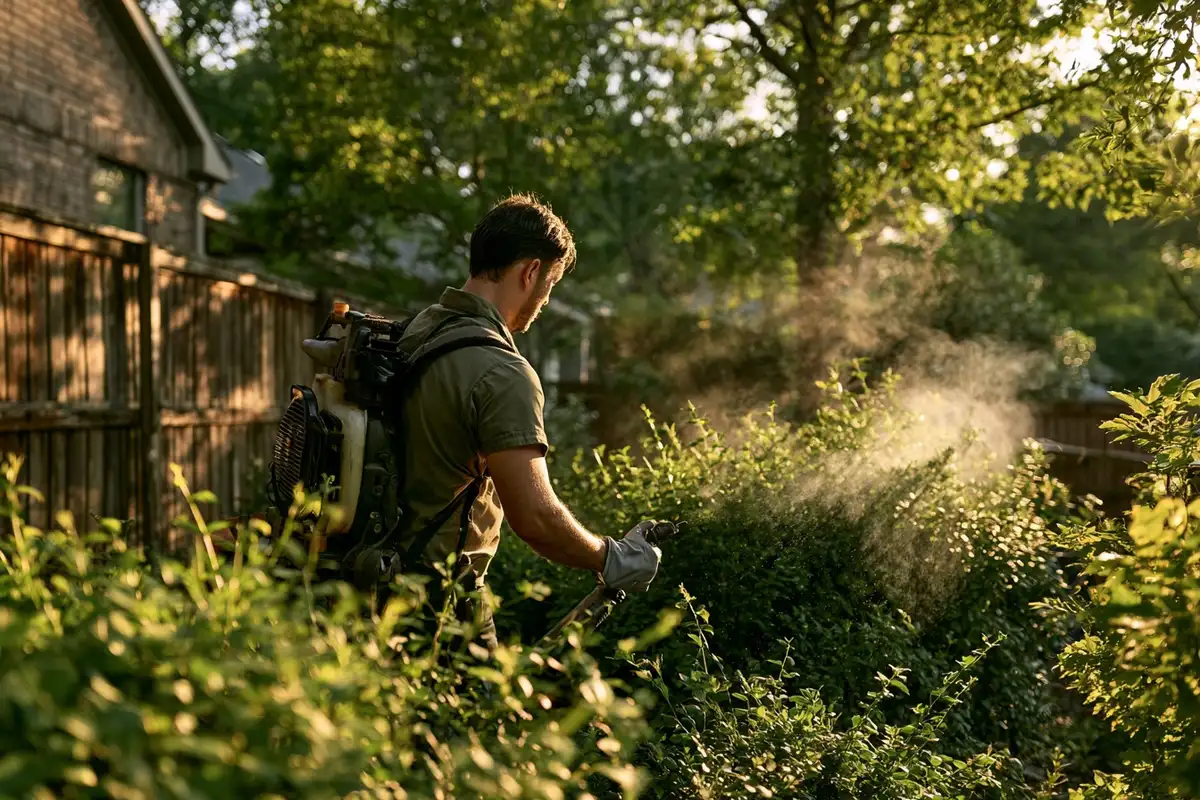
A barrier treatment is a residual application on the places mosquitoes and ticks rest and wait: shrubs, the underside of leaves, fence lines, tall grass, the edge of the woods and the shaded parts of the lawn. It does not make a yard bug-free and it does not replace repellent, long sleeves and a tick check. We do the service alongside removing standing water and keeping the lawn trimmed, and we tell you which of those are worth doing.
What mosquito and tick control costs in Rockford
These are typical U.S. ranges from national cost guides, not quotes. The price rises with the size of the lot and with how much brush, woods or water sits at the edge. The exterminator cost page has every pest and the plan prices.
| Job | Typical cost | Source |
|---|---|---|
| Mosquito yard treatment, per visit | $80 to $150 per visit | HomeGuide |
| Mosquito yard treatment, per season | $350 to $1,000 per season | HomeGuide |
| Tick yard treatment | $100 to $250 per treatment | HomeGuide |
| Flea treatment, inside the house | $200 to $400 per visit | HomeGuide |
| General pest inspection | $50 to $200 per inspection | HomeGuide |
A season plan is the better deal if you want protection from spring to fall, because a single treatment wears off. Ticks and mosquitoes also behave differently, so the treatment for one is not always a treatment for the other. We look at the yard first and tell you which you need.
Mosquitoes and West Nile virus in Winnebago County
The mosquito that spreads West Nile in Illinois is Culex, the house mosquito, and it bites from dusk to dawn(IDPH). Mosquitoes breed in stagnant ditches, tree holes, old tires, clogged gutters, tin cans and anything that holds water, and floodwater mosquitoes emerge about two weeks after heavy rain (IDPH).
The county health department sampled mosquitoes in 2024. It tested 15 samples, and 1 was positive for West Nile, collected on May 13, 2024 in Rockford ZIP 61104. There were 4 human West Nile cases in Winnebago County that year, and the county rated the risk to residents as low. Two dead blue jays from ZIP 61107 also tested positive (Winnebago County Health Department). Continuous rain in June 2024 lowered the production of the Culex mosquito that transmits West Nile (county annual report). In 2025, the first positive mosquito pool in all of Illinois was collected in Rockford on May 9, 2025, and the county was on IDPH's list of counties reporting West Nile by June 18, 2025 (IDPH, IDPH). Statewide, Illinois had 69 confirmed human cases in 2024, including 13 deaths. Symptoms usually appear 3 to 14 days after a bite. The West Nile virus in Rockford guide has the full picture.
Ticks and Lyme disease in Winnebago County
Winnebago County had 41 human Lyme disease cases in 2024, along with 6 anaplasmosis, 2 ehrlichiosis and 5 spotted fever cases (Winnebago County Health Department). The county's own tick drags in 2024 were small, 4 drags that collected 7 ticks, and none tested positive for Lyme or the other pathogens it watches. A University of Illinois study found tickborne diseases reported every month of the year and in every Illinois county, with higher Lyme rates in northern counties (University of Illinois).
IDPH says the deer tick is common mostly in limited areas of northern Illinois. Its larvae and nymphs are active in spring and early summer, and adults may be active in spring and fall. American dog tick adults are most active in April through June, and the lone star tick is most active from April through the end of July. Ticks can be active on winter days when ground temperatures are about 45 degrees (IDPH). Illinois Extension adds that milder winters and earlier springs let ticks overwinter more easily (Illinois Extension). A ring-like rash shows up in about 70 to 80 percent of cases, three to 32 days after the bite (IDPH). See the ticks and Lyme in Winnebago County guide for what to do after a bite.
Fleas are a section of the same job
A flea treatment indoors typically runs $200 to $400 per visit (HomeGuide). We treat the rooms where your pet sleeps and the shaded parts of the yard where wildlife and pets pass. Your vet treats the pet. Fleas are one of the pests where the order of work matters, so here is what the sources say.
Why you see so few of the fleas that are there
Mississippi State says eggs, larvae and pupae far outnumber the adult fleas you see, so a treatment has to reach the immature stages. Females start laying eggs within 2 days of feeding, and the larvae feed on adult flea droppings, which are digested blood, in bedding and carpet (Mississippi State Extension, Texas A&M AgriLife Extension). The cocoon stage lasts from a week to several months, which is why fleas keep appearing after a treatment, and pupae are hard to control. Washington State says pupae wait for the vibration of footsteps, so a house that has sat empty can have a sudden outbreak when someone walks in (Washington State University). Illinois Department of Public Health says adults emerge from the cocoons about a month after the eggs are laid (IDPH).
| Stage | What the sources say | Why it matters |
|---|---|---|
| Adults | Females start laying eggs within 2 days of feeding (Texas A&M) | Fleas multiply fast once a pet brings them in |
| Eggs and larvae | Far outnumber adults. Larvae feed on adult flea droppings in bedding and carpet (Mississippi State, Texas A&M) | Vacuuming reaches these stages: up to 60 percent of eggs and 30 percent of larvae |
| Pupae | The cocoon stage lasts a week to several months, and pupae wait for footstep vibration (Mississippi State, Washington State) | Pupae are hard to control, so repeat treatments catch the ones that hatch later |
| New adults | About a month after eggs are laid, adults emerge from cocoons (IDPH) | Follow-up 5 to 10 days after the first treatment, per the CDC |
The steps that work
- Treat every pet at the same time as the house. The CDC says every pet must be treated and the home treatment started together (CDC). Your vet picks the pet product.
- Vacuum. Texas A&M says vacuuming removes up to 60 percent of eggs and 30 percent of larvae. It also says fleas can keep developing inside a vacuum bag, so throw the bag out after each use.
- Wash pet bedding hot. Mississippi State lists treating pets, vacuuming and washing bedding in hot water as the steps before a heavy infestation gets an adulticide plus an insect growth regulator.
- Repeat in 5 to 10 days. The CDC calls for two or more follow-up treatments 5 to 10 days after the first, which catches the fleas that were still in cocoons.
- Follow the label. Mississippi State says more insecticide than the label allows does not help.
CDC also notes that some fleas spread plague and murine typhus (CDC). That is a reason to take a flea problem seriously, not a reason to panic. If you only have a mosquito or tick problem and no pets, skip this section.
Illinois rules for yard barrier treatments
Illinois has two rules we follow and will explain at your door. First, the law since 2023 requires commercial applicators to place a 4 by 5 inch white lawn marker at a usual point of entry on homes treated with barrier mosquitocides. Second, a neighbor whose property abuts or is adjacent to a client may request prior notice of a barrier mosquitocide treatment (Illinois Extension IPM). Illinois also treats mosquito work as its own applicator category, Category 8, Public Health Pest Control (Illinois Department of Agriculture) (Illinois Administrative Code).
For lawn care products, Illinois separately requires applicators for hire to be certified and licensed, and requires labels and safety data sheets to be provided on request (Lawn Care Act, Illinois Extension). We follow the label on every product we use, and we give you the product name and the label on request.
Community spraying is not the same as a yard treatment
Illinois says where mosquito fogging exists, it is locally funded and run by village or city governments, sometimes through a mosquito abatement district (IDPH). Coverage differs from town to town. For example, the Village of Roscoe ended its roughly $25,000-a-year contracted mosquito program for the 2026 season (WIFR). If your town stopped or never had a program, a yard treatment is how you get a barrier on your property. Check with your village or city to see what it does, and see Roscoe, Loves Park and Machesney Park for local notes.
What to do between treatments
- Empty or turn over anything that holds water: buckets, tires, planters, bird baths and clogged gutters.
- Keep grass short and cut back brush where the yard meets the woods.
- Use an EPA-registered repellent and check yourself, kids and pets for ticks after time outside.
- Stack wood off the ground and away from the house, and keep play areas away from the tree line.
If a wasp nest is also in the yard, see wasp nest removal, and we can handle it in the same visit. For indoor insects, the quote page takes a photo or a description.
Sources (25)
- HomeGuide, mosquito control cost
- HomeGuide, exterminator cost
- HomeGuide, flea exterminator cost
- Illinois Department of Public Health, mosquitoes
- Illinois Department of Public Health, West Nile virus
- Illinois Department of Public Health news release, first West Nile positive mosquito pool of 2025
- Illinois Department of Public Health news release, West Nile counties and 2024 totals
- Winnebago County Health Department, 2024 vector surveillance report
- Winnebago County Health Department, 2024 annual report
- Illinois Department of Public Health, common ticks
- Illinois Department of Public Health, Lyme disease
- Illinois Extension, tick concerns are growing
- University of Illinois News, tickborne diseases reported every month and in every county
- University of Illinois Extension, barrier mosquitocide lawn marker and notice law
- Illinois Administrative Code, Title 8 Part 250 (pesticide applicator categories, Category 8 mosquito)
- Illinois Lawn Care Products Application and Notice Act (415 ILCS 65)
- Illinois Extension, Illinois Lawn Care Application and Notice Act
- Illinois Department of Public Health, mosquito spraying FAQs
- WIFR, Roscoe village board cuts $25K mosquito control program for 2026 season
- Mississippi State Extension, P2597 Web
- Texas A&M AgriLife Extension, Controlling Fleas
- Washington State University, Fleas
- Illinois Department of Public Health, Fleas
- CDC, Index
- CDC, Getting Rid
Where this is done
Mosquito and Tick Control across Rockford and the cities and villages around it. Each town page covers that town's own housing age, property rules and mosquito program; the full list is on the service area page.
Ready for a price on mosquito and tick control?
Call, text, or send the form. You get a price back before any work is scheduled.
Mosquito and Tick Control: questions
How much does mosquito control cost?
National guides put a mosquito yard treatment at $80 to $150 per visit and a season of treatments at $350 to $1,000 per season. Tick treatment typically runs $100 to $250 per treatment. These are typical U.S. ranges, not a Rockford quote. See the cost page.
Does a barrier treatment kill ticks too?
We treat the tall grass, leaf litter and wood edges on a tick visit, and a mosquito treatment goes on different parts of the yard. Neither replaces a tick check or repellent.
Is West Nile virus a risk in Rockford?
West Nile is present in Winnebago County. In 2024 there were 4 human cases and the county rated the risk to residents low, and in 2025 the first positive mosquito pool in Illinois was collected in Rockford. See the West Nile guide.
How common is Lyme disease in Winnebago County?
The county reported 41 human Lyme disease cases in 2024. IDPH says the deer tick is common mostly in limited areas of northern Illinois. See the ticks and Lyme guide.
Do I need a lawn marker after a mosquito treatment?
The law requires commercial applicators to place a 4 by 5 inch white lawn marker at a usual point of entry on homes treated with barrier mosquitocides. A neighbor whose property abuts yours may request prior notice of a treatment.
Does the village spray for mosquitoes?
It depends on the town. Where mosquito fogging exists it is locally funded and run by the village or city. For example, the Village of Roscoe ended its roughly $25,000-a-year contracted mosquito program for the 2026 season. Ask your village hall what it does this year.
Can you treat fleas in the yard?
We treat fleas in the house and in the shaded parts of the yard where pets and wildlife pass. An indoor flea treatment typically runs $200 to $400 per visit. The CDC says every pet must be treated when the home treatment starts, and that two or more follow-up treatments 5 to 10 days later are needed.
Does vacuuming help with fleas?
Vacuuming helps a lot. Texas A&M says vacuuming removes up to 60 percent of flea eggs and 30 percent of larvae. Throw the vacuum bag out afterward, because fleas can keep developing inside it.
How long does a yard treatment last?
National guides price a season of visits and not a single treatment, and the season price is shown on this page. We tell you the schedule that fits your lot before you commit.
Other services
Mosquito and Tick Control: get a written price
Tell us the pest, the town and where you are seeing it. A licensed exterminator replies with a price, and no work starts until you agree to it.
Prices and the full service list are on the homepage for a exterminator in Rockford.