
Termite Inspection for a Home Sale in Illinois
Updated
Short answer
Part of Termite Treatment.
Get a free quote
A licensed exterminator replies with a price. Nothing is booked until you say yes.
If you are selling or buying a house in Rockford, a termite inspection is one of the items that can show up in the contract. The report is called a wood destroying insect report, a WDI report, a termite letter or a clearance letter. They all mean the same thing: a licensed inspector looked at the house and wrote down what was found. This guide covers what the report is, when a lender asks for it, what it costs and how to read it. For treatment itself, see termite treatment.
What a wood destroying insect report is
The form most lenders and agents use is the NPMA-33, the Wood Destroying Insect Inspection Report. HUD keeps a copy, and it asks for the inspection company's pest control business license number and the inspector's license or certification number (HUD, NPMA-33). That is a built-in way to confirm the inspector is licensed. The guide on how to check an exterminator license in Illinois shows how to verify what is on the form.
When a lender requires it
HUD's Single Family Housing handbook says that for existing properties the FHA lender must confirm the property is free of wood destroying insects and organisms, and it names the NPMA-33 or a state-mandated report as the file document (HUD handbook 4000.1). Other loan types and individual buyers can ask for the same report in the purchase contract. If a buyer or lender wants it, the seller usually orders it. The contract decides who pays.
One FHA detail matters if treatment turns up. HUD says soil poisoning is unacceptable for treating termites unless the lender gets assurance that it will not endanger the water supply (HUD handbook). On a property with a private well, ask your inspector about that before a treatment is chosen. The EPA gives the same warning in general terms: improper barrier treatments can contaminate the home and nearby drinking water wells, so hire a licensed, trained professional (U.S. EPA).
What the report does not promise
HUD states that the NPMA-33 reflects only the day of inspection and is not a guarantee against hidden or future infestation (HUD, NPMA-33). A clean report means the inspector saw no signs in the places they could reach. It does not mean the house is termite-proof. That is worth saying to a buyer, and worth remembering as one.
What a termite letter costs
National cost guides give these typical U.S. ranges. They are not Rockford quotes. The exterminator cost page lists every price and where it came from.
| Item | Typical cost |
|---|---|
| Termite clearance letter for a home sale | $100 to $200 per letter (Angi, HomeGuide) |
| Termite inspection, any purpose | $75 to $325 per inspection (Angi) |
| Bait stations, whole home, if treatment is needed | $1,000 to $2,500 per home (HomeGuide) |
| Liquid soil barrier, if treatment is needed | $3 to $20 per linear foot (HomeGuide) |
What to expect on inspection day
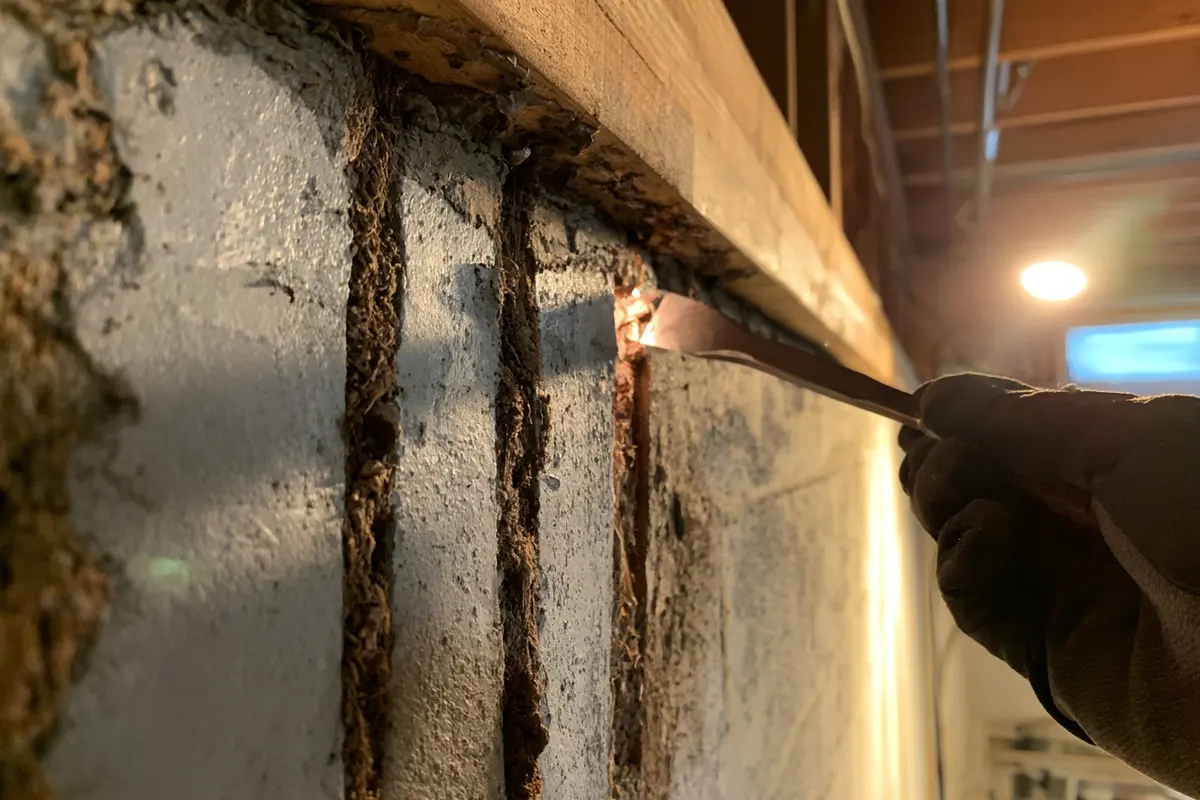
The inspector looks at the foundation, the basement or crawl space, sill plates, floor joists, window frames, porch posts and any wood that touches soil. Termites build moist mud tubes to seal their tunnels, and the nest sits in the the soil below slabs or basement floors or in soil around the home (Illinois Extension). In an older house, that means the places where the foundation meets the framing get the most attention. The age of Rockford homes is why: the city's median home dates to 1965 (Census ACS 2024).
Before the inspector arrives, clear access to the basement walls, the furnace area and the crawl space hatch. Stored boxes against walls hide the evidence.
If the report finds termites
The report lists what was found and where. The next step is a treatment plan with a written price. The University of Illinois School IPM page says that once workers are feeding inside a structure, treatment is a soil termiticide around the structure and/or bait (U of I School IPM). Get the treatment quote in writing and ask what the work covers. A seller who treats before closing should keep the paperwork for the buyer.
For sellers: how to get ahead of the report
A seller who orders the inspection before listing sees the result first and can price the repair or treatment into the sale instead of discovering it under a deadline. Fix the things that invite termites and hide them: wood in contact with soil, mulch piled against siding and stored lumber against the foundation. Gather any prior treatment paperwork too. Bait systems usually carry yearly monitoring, which national guides price at $200 to $400 per year (HomeGuide), and a buyer will ask whether that contract transfers.
For buyers: read the form, not just the headline
The NPMA-33 asks for the inspection company's business license number and the inspector's license or certification number (HUD, NPMA-33). Read which areas were inaccessible. A finished basement with no access to the sill plate means those parts were not checked, and HUD's own wording is that the report reflects only the day of inspection. If you are buying an older house, that is worth a conversation. Rockford's median home dates to 1965, and the county's dates to 1972 (Census ACS 2024).
Liquid barrier or bait: how the choice affects a sale
The EPA says soil-applied barrier treatment is the most common technique, while bait systems use a slow-acting insecticide in cellulose bait (U.S. EPA). The practical difference for a sale is paperwork. A barrier is a one-time application, and a bait system comes with stations to check. For an FHA buyer, remember the HUD caution on soil treatment near a water supply. Ask the company which method it recommends for your lot and why.
We do termite inspections and treatment in Rockford, Belvidere and Cherry Valley. Rockford Bug Guys works under an Illinois Department of Public Health structural pest control license with a certified technician. If you are not sure whether the bugs on your windowsill are termites, start with termite swarmers vs flying ants.
Sources (9)
- HUD Single Family Housing Policy Handbook 4000.1 (wood destroying insects)
- NPMA-33 Wood Destroying Insect Inspection Report (HUD copy)
- U.S. EPA, termites: how to identify and control them
- University of Illinois Extension, Ask Extension, termite nests and control
- University of Illinois School IPM, subterranean termites
- Angi, termite inspection cost
- HomeGuide, termite inspection cost
- HomeGuide, termite treatment cost
- U.S. Census Bureau, ACS 2024 1-year, tables B25034 and B25035 (via Census Reporter)
Want a price for your own house?
Call, text, or send the form. You get a price back before any work is scheduled.
Quick answers
How much does a termite inspection for a home sale cost?
Angi puts a termite clearance letter for a home sale at $100 to $200 per letter. Those are typical U.S. ranges, not a Rockford quote. See the exterminator cost page for the full table.
Does Illinois require a termite inspection to sell a house?
We found no Illinois statute that requires one for every sale, so we do not say the state does. A lender or the purchase contract often does. HUD requires the FHA lender to confirm the property is free of wood destroying insects.
What is an NPMA-33?
It is the Wood Destroying Insect Inspection Report, the standard form for termite and wood-destroying insect inspections. HUD keeps a copy, and the form asks for the company's business license number and the inspector's license or certification number.
Does a clean termite report guarantee no termites?
HUD says the NPMA-33 reflects only the day of inspection and is not a guarantee against hidden or future infestation.
Who pays for the termite inspection, the buyer or the seller?
The purchase contract decides. In many sales the seller orders the report when the buyer's lender requires it. Read the contract or ask your agent before you book it.
How long does a termite inspection take?
Time depends on the size of the house and how much of the basement or crawl space is clear. We do not promise a set time on a guide page. Ask when you book.
What if the inspector finds termites before closing?
Get a written treatment plan and price. Bait systems and soil barriers are the two common treatments, and the FHA caveat on soil treatment near water supplies applies to FHA loans. Keep the paperwork for the buyer.
Want a price on the job?
Tell us the pest, the town and where you are seeing it. A licensed exterminator replies with a price before any work starts.
Prices and the full service list are on the homepage for a exterminator in Rockford.