
Carpenter Ant Treatment in Rockford, IL
Get a free quote
A licensed exterminator replies with a price. Nothing is booked until you say yes.
Updated
Short answer
Carpenter ants are the big black ants that show up in kitchens and bathrooms and along baseboards, often at night. They are active from spring (March-April) through early fall (September-October) (IDPH). Unlike termites, they do not eat wood. IDPH says they hollow it out for nests, and that they are more of a nuisance than a structural threat, although large colonies can be destructive. We treat them as a problem worth fixing early, because the ants you see are a small part of a colony that is living somewhere in your house or yard. If you are not sure whether you have ants or termites, start with the carpenter ants vs termites guide. For small ants in a kitchen, ant control is the page you want.
What carpenter ant treatment costs in Rockford
Carpenter ants have only one national cost guide, so treat the number below as a rough range. It is a typical U.S. range, not a quote. The exterminator cost page has every pest on one table.
| Job | Typical cost | Source |
|---|---|---|
| Carpenter ant treatment | $250 to $500 per treatment | HomeGuide |
| Ant extermination, any species | $100 to $500 | Angi |
| General pest inspection | $50 to $200 per inspection | HomeGuide |
| One-time general pest control visit | $108 to $261 per visit | HomeAdvisor |
| Termite inspection, if the wood looks suspect | $75 to $325 per inspection | Angi |
The low end is a nest that is easy to reach, such as one in a stump, a firewood stack against the house or an open wall void. The high end is a colony with satellite nests in more than one part of the house, or a parent nest outdoors that has to be found before indoor treatment will hold. The inspection is where we learn which one you have, so we do it before we quote a treatment.
Signs of a carpenter ant nest in your house
| What you see | What it usually means | What we do |
|---|---|---|
| Large black ants walking in kitchens, bathrooms or along baseboards, especially at night | Foraging workers. A nest is close, indoors or just outside | Follow the trail at dusk to find where they enter and leave |
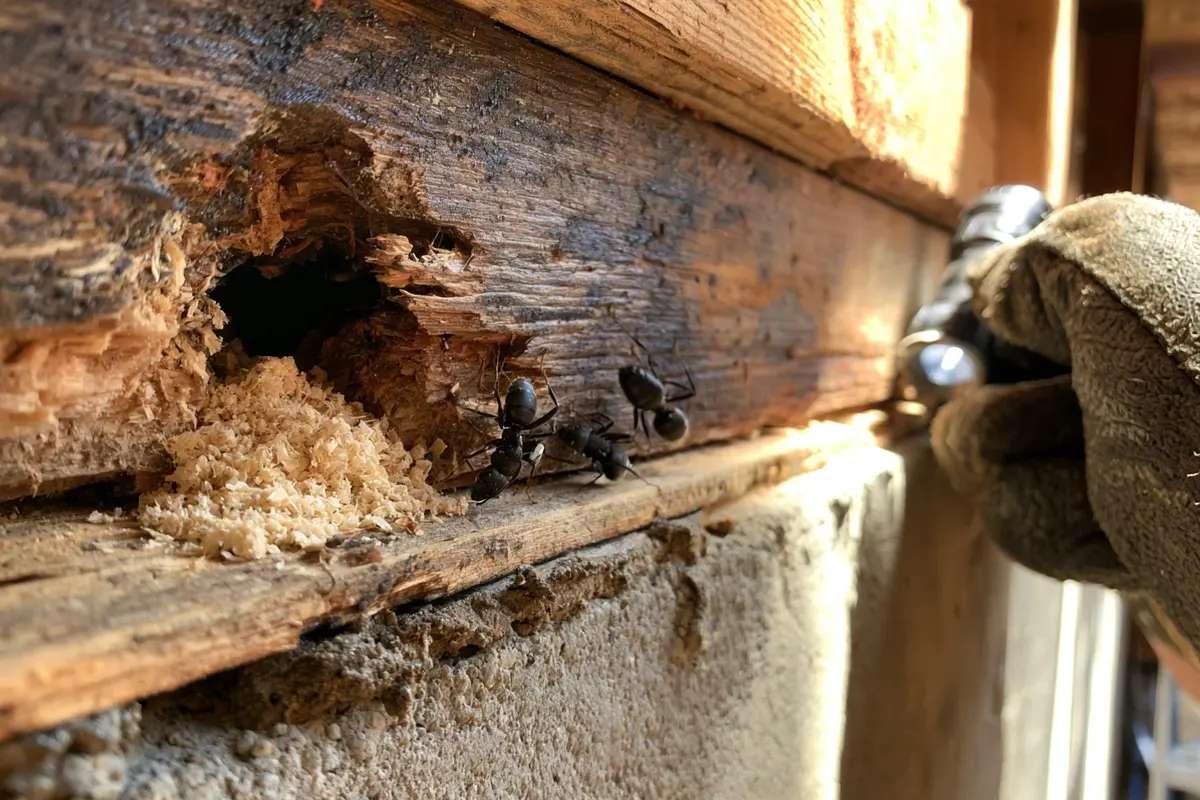
| Small piles of coarse sawdust-like shavings under a window sill, baseboard or wall void | Frass pushed out of a nest gallery. Carpenter ants dump it, they do not eat it | Probe the wood and treat the gallery |
| Ants coming out of a wall outlet, trim or an old window frame | A nest in a wall void or in a frame with wet or rotted wood | Open the void where needed and treat the nest |
| Winged insects indoors | Could be carpenter ants or termites, and the treatment differs | Collect a few and identify them before anything is sprayed |
| Ants around a tree, stump or woodpile near the house | The colony may have a parent nest outdoors | Check outdoors and indoors in the same visit |
Frass is the most useful clue. NPIC says carpenter ants leave sawdust-like frass, where termites leave pellets or mud, and the University of Maryland says coarse frass like pencil shavings means a nest is close (NPIC, University of Maryland Extension). IDPH adds that carpenter ant galleries are smooth and clean, while termite tunnels are lined with mud (IDPH). When we are not sure which one it is, we say so and inspect the wood before we treat.
Why carpenter ants nest in damp wood
Carpenter ants tunnel wood to nest, and Colorado State Extension says they prefer decayed or water-damaged wood. It lists leaky roofs, clogged gutters and bad flashing as the things that invite them, and it says the damage develops slowly, which gives you time to plan control (Colorado State Extension). NPIC makes the same point from the control side: because the ants prefer damp wood, ventilation and leak repair are part of getting rid of them (NPIC). A roof leak above a ceiling, a failed seal on a window or a wet deck ledger are the kinds of spots we look at first.
IDPH describes a carpenter ant colony as a parent nest outside plus satellite nests, and the satellite is the part usually found inside a house. Killing the indoor satellites may not stop the colony, because the outdoor parent can reinfest. Finding the parent nest is the critical step, since destroying it eliminates the queen (IDPH). University of California IPM notes that an indoor nest can hold several thousand ants and is a satellite of a parent nest outdoors (UC IPM). This is why a thorough job looks at both. Rockford housing is on the older side, with a median build year of 1965 (Census ACS 2024), which means more roofs, window frames and porches that have had time to leak.
How we treat carpenter ants
- Inspect and trace. We look for the trail, the frass and the damp wood, and we check the yard for stumps, firewood and trees that touch the house.
- Find the nests. We aim to locate the parent nest and every satellite nest, using moisture readings and a probe where the wood looks soft. Many species are nocturnal, so Colorado State suggests inspecting at night, and Penn State says a stethoscope or an inverted glass held to a wall can pick up the rustling of a satellite nest (Colorado State Extension, Penn State Extension).
- Treat the nests directly. We use EPA-registered products applied according to the label, by a certified technician working under an Illinois Department of Public Health license. Nest voids get treated where the colony lives. We use bait where it fits the situation.
- Treat the entry points and the perimeter. This cuts off the trails while the nests die back.
- Tell you what fed the problem. We point out the leak, the touching branch or the wet wood. Fixing it is a roofer, carpenter or plumber job, and we do not do that work.
IDPH notes that routine spraying of ants and their trails rarely cures the problem, since there are many more ants where those came from, and that baits work better once food sources are removed (IDPH). That advice applies to carpenter ants too. Spraying a wall full of workers feels productive and leaves the nest alone.
Carpenter ants or termites
This is the question that costs people money, because the two get treated very differently. The short version is that carpenter ants hollow wood and push the shavings out, and subterranean termites eat wood from the soil up. The body shape also tells them apart. Carpenter ants have a narrow waist, elbowed antennae and hind wings shorter than their front wings. Termites have no wasp waist, straight antennae and wings of equal length (University of Minnesota Extension, Colorado State Extension). Carpenter ant workers run about 3/8 to 1/2 inch. The common destructive termite in Illinois is the eastern subterranean termite, which nests in the soil below slabs and basement floors or in the soil around the home (U of I, Illinois Extension). Illinois Extension calls finding winged termites inside or outside a red flag that the home should be inspected (Illinois Extension).
| Carpenter ant | Subterranean termite | |
|---|---|---|
| Eats wood | No, it hollows wood for a nest | Yes, it feeds on the wood |
| Waist and antennae | Narrow waist, elbowed antennae | No pinched waist, straight antennae |
| Wings, if winged | Hind wings shorter than the front wings | Wings of equal length |
| Where the nest is | Decayed or water-damaged wood, with a parent nest outside and satellites inside | In the soil under or beside the house |
| What you find | Sawdust-like frass, smooth clean galleries and big black ants | Pellets or mud, tunnels lined with mud |
| Our page | Carpenter ant treatment | Termite treatment |
If you found winged insects, the termite swarmers vs flying ants guide shows how to tell them apart.
When carpenter ants are active, and what that means for timing
IDPH says carpenter ants are active from spring (March-April) through early fall (September-October), and that colonies go dormant in winter, though indoor nests may stay active (IDPH). Two practical points follow. First, an ant you see in January is a different kind of sighting from one in June, and it is worth telling us when you saw it, because it can mean a nest inside the heated part of the house. Second, colonies being dormant in winter does not make winter a good time to wait. Colorado State says damage develops slowly, which gives time to plan, but a plan needs a start date (Colorado State Extension). Spring, when the trails start again, is the easiest time to follow them back to a nest.
What to do before we arrive
- Do not spray the ants. Spraying ants rarely cures the problem (see the IDPH note above), and the trail you can see is how we find the nest.
- Save a few ants in a jar or on a piece of tape. It lets us identify them before we plan the treatment. IDPH also takes specimens through its Arthropod Specimen Form (IDPH FAQ).
- Move firewood and lumber away from the house and trim any branch that touches the roof or siding.
- Fix or report the leak. If you know where a roof, window or pipe leaks, tell us. It is the first place we look.
- Note when you see the ants and which room. Night sightings in a kitchen point to a different nest than daytime ants outdoors.
Carpenter ant treatment near Rockford
We treat carpenter ants across Rockford and the surrounding towns, including Loves Park, Machesney Park, Roscoe and Rockton. A wooded lot, an older house with a wet basement or a home with a big tree beside the roof is where we expect to find them. For any other ant, see ant control. When the bugs are inside the walls and you also hear scratching, rodent control covers that. The quote page takes a description or a photo of the frass.
Sources (21)
- Illinois Department of Public Health, carpenter ants
- HomeGuide, ant exterminator cost
- Illinois Department of Public Health, ants
- Angi, pest control service cost
- HomeGuide, pest control prices
- HomeGuide, exterminator cost
- HomeAdvisor, hire an insect control service
- Angi, termite inspection cost
- HomeGuide, termite inspection cost
- University of Illinois, Home, Yard and Garden Pest Newsletter, termites
- University of Illinois Extension, Ask Extension, termite nests and control
- University of Illinois Extension, swarming insects season
- Illinois Department of Public Health, Structural Pest Control FAQ
- U.S. Census Bureau, ACS 2024 1-year, tables B25034 and B25035 (via Census Reporter)
- Illinois Department of Public Health, Carpenter Ants
- Colorado State Extension, Carpenter Ants
- University of Minnesota Extension, Carpenter Ants
- National Pesticide Information Center, Carpenterant
- University of Maryland Extension, Carpenter Ants
- Penn State Extension, Carpenter Ants
- UC IPM, Pest Notes
Where this is done
Carpenter Ant Treatment across Rockford and the cities and villages around it. Each town page covers that town's own housing age, property rules and mosquito program; the full list is on the service area page.
Ready for a price on carpenter ant treatment?
Call, text, or send the form. You get a price back before any work is scheduled.
Carpenter Ant Treatment: questions
How much does carpenter ant treatment cost?
One national guide puts carpenter ant treatment at $250 to $500 per treatment. That is a typical U.S. range, not a Rockford quote, and a large colony with more than one nest costs more. See the exterminator cost page for other pests.
Do carpenter ants eat wood?
They do not. IDPH says carpenter ants hollow wood for nests but do not eat it. They push the shavings out, which is the frass you find in small piles. Large colonies can still cause damage over time.
What does carpenter ant frass look like?
Frass looks like sawdust, and coarse frass like pencil shavings means a nest is close, according to the University of Maryland. Termites leave pellets or mud instead, and their tunnels are lined with mud while carpenter ant galleries are smooth and clean. The carpenter ants vs termites guide shows the difference.
Where do carpenter ants nest in a house?
Usually in decayed or water-damaged wood, which is why leaky roofs, clogged gutters and bad flashing invite them. A colony can have a parent nest outdoors and satellite nests indoors, and the satellite is what is usually found inside a house.
When are carpenter ants active in Illinois?
IDPH says they become active in spring and stay active until early fall, which it gives as spring (March-April) through early fall (September-October). IDPH also says colonies go dormant in winter, though indoor nests may stay active.
Can I treat carpenter ants myself?
You can kill the ants you see, but IDPH notes that spraying ants and their trails rarely cures the problem. The nest has to be found and treated. If you keep seeing ants after a spray, call us and we will trace them.
Are carpenter ants or termites worse?
They are different problems. Termites eat wood, and carpenter ants hollow it for a nest. Colorado State says carpenter ant damage develops slowly, but both need a professional inspection if you find damaged wood. See termite treatment if you find mud tubes or winged termites.
Will treatment fix the damp wood?
Treatment does not fix the leak. We treat the ants and tell you where the moisture is coming from. A roofer, carpenter or plumber has to fix the leak, because carpenter ants will come back to wet wood.
Other services
Carpenter Ant Treatment: get a written price
Tell us the pest, the town and where you are seeing it. A licensed exterminator replies with a price, and no work starts until you agree to it.
Prices and the full service list are on the homepage for a exterminator in Rockford.