
Termite Swarmers vs Flying Ants: How to Tell
Updated
Short answer
Part of Termite Treatment.
Get a free quote
A licensed exterminator replies with a price. Nothing is booked until you say yes.
A cluster of winged insects on a windowsill is one of the few moments a termite problem shows itself. Most of the time termites stay out of sight, inside wood and soil. The winged ones come out to start new colonies, and that is when a homeowner gets a look. Flying ants do the same thing, which is why the two get mixed up. The difference is easy to see once you know where to look, and the answer decides whether you vacuum and move on or book a termite treatment.
How to tell a termite swarmer from a flying ant
Illinois Extension describes the difference as quite clear. Both insects have two sets of wings, but the body and the wings differ (Illinois Extension, swarming insects). Catch one on tape or in a jar and check three things.
| What to check | Flying ant | Termite swarmer |
|---|---|---|
| Waist | Pinched waistline | No pinched waist |
| Antennae | Elbowed | Straight and beaded |
| Wings | Clear and lightly veined, starting from the same place on the thorax | Whitish and gossamer, starting from two different spots on the body and lying parallel |
| Wing length | Front and hind wings differ in size | Wings of equal length |
The antennae and wing-length rows come from Mississippi State and Maryland Extension, which describe termite swarmers as having straight beaded antennae, equal wings and no pinched waist, while ants have elbowed antennae and a narrow waist (Mississippi State Extension, University of Maryland Extension). Texas A&M AgriLife puts a swarmer at about 3/8 inch (Texas A&M AgriLife). The color check works in one direction only. Extension notes that only the termite destined for flight is dark, while the termites inside the colony are small, white and fleshy. A pale, soft insect in a wall or under a board is a worker, not a swarmer, and it is a worse sign than a dark one on the window.
Why they show up inside the house
Both insects swarm as part of a normal life cycle. The winged ones come up from a colony below ground, fly off, lose their wings and start a new colony. They end up indoors when the colony is close to the house. Extension says a colony under the slab can reach the living space by following heating ducts or utility lines, and in homes with basements the colony can sit just outside and slip in through the cracks between the foundation walls and the sill plate (Illinois Extension).
Rockford has plenty of the kind of house where that happens. The median home here was built in 1965, and 20.1% of homes date to 1939 or earlier (Census ACS 2024). An older foundation can have more seams and more places where wood sits close to soil, which are worth a look during an inspection.
What to do the day you see them
- Do not spray them. The University of Illinois School IPM page says swarmers do not bite, carry disease or damage wood, and tells homeowners to vacuum them up rather than spray (U of I School IPM).
- Save a few. Put some in a sealed container or tape them to a card so an inspector can identify them.
- Note where they came from. A window, a floor vent, a basement wall or a crawl space door all tell the inspector where to look first.
- Call for an inspection. Extension says finding winged termites outdoors or indoors is a red flag that the home should be inspected (Illinois Extension). If it turns out to be ants, the inspection cost you a little and ruled out the worst case.
What a termite inspection costs in Rockford
National cost guides put a termite inspection at $75 to $325 per inspection (Angi, HomeGuide). That is a typical U.S. range, not a Rockford quote. The full price picture, including treatment, is on our exterminator cost page. If termites are found, the usual treatment is a soil termiticide around the structure and/or bait, and the termite pages explain how each one works.
When it is probably just ants
Winged ants that turn up indoors may only be ants. Extension says outside their natural setting winged ants do not last long and a vacuum cleaner is all you need (Illinois Extension). If ants keep returning or you find them in the kitchen, see ant control. If the ants are large and show up in walls or damp wood, the question is different, and carpenter ants vs termites covers it.
What the place you find them tells you
Kentucky Extension makes a useful distinction. Swarmers outdoors next to a stump do not prove the house is infested, but swarmers at the foundation or on the porch do, and Texas A&M says swarmers inside the house point to an active infestation in the structure (University of Kentucky Entomology, Texas A&M AgriLife). Maryland Extension adds that swarmers do not damage wood and most die indoors from dryness (University of Maryland Extension). So a pile of dead swarmers and wings on a windowsill is the sign, and the swarmers themselves are not the harm.
Missouri Extension says a colony takes years before it makes swarmers, and that swarms in the Midwest come in spring on warm sunny days after rain (University of Missouri Extension). We did not find an Illinois source that gives the swarm months for Rockford, so we do not name any. If you see swarmers at any time of year, treat it the same way.
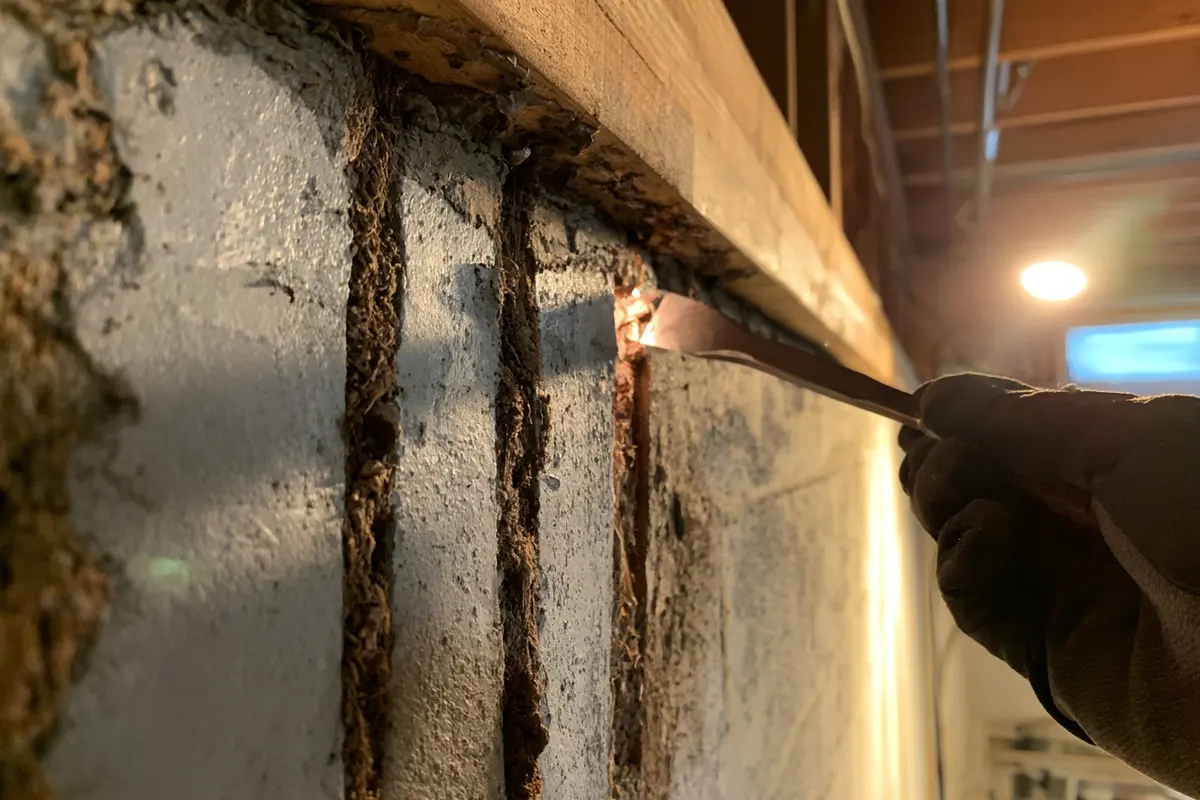
While you are at the foundation, look for mud tubes. They appear on foundation walls, piers and cracks, and they blend in with soil or concrete. Kentucky Extension says to break one open to check for live termites, and that an empty tube can still mean past activity (University of Kentucky Entomology).
Where the colony is while the swarmers fly
The swarmers you see are the visible edge of something underground. The common destructive termite in Illinois is the eastern subterranean termite, and its nest sits in the soil below slabs or basement floors or in soil around the home (U of I, Home, Yard and Garden Pest Newsletter, Illinois Extension). Termites bring moist mud to seal their tunnels, so mud tubes on a foundation wall or a joist are the other thing to look for while you are checking the windowsill. The workers travel between the soil and the wood they eat, which is how a colony outside the house ends up feeding on the house.
What happens if the inspection finds termites
The EPA describes two main approaches. Soil-applied barrier treatment is the most common technique, and common active ingredients include fipronil and imidacloprid. Bait systems use cellulose bait with a slow-acting insecticide (U.S. EPA, termites). The EPA also warns that improper barrier treatments can contaminate the home and nearby drinking water wells, so the work belongs with a licensed, trained professional. Everything is applied as EPA-registered product according to the label.
National cost guides put a liquid barrier at $3 to $20 per linear foot and a whole-home bait system at $1,000 to $2,500 per home, with annual monitoring at $200 to $400 per year (HomeGuide, termite treatment cost). Those are typical U.S. ranges, not Rockford quotes, and a written quote after an inspection is the only number that applies to your house.
Carpenter ants swarm too
Not every winged insect with a pinched waist is a harmless nuisance. IDPH says carpenter ants hollow wood for nests but do not eat it, and they are more nuisance than structural threat, with activity running from spring through early fall (IDPH, carpenter ants). They still point to damp or damaged wood, which is worth fixing. Our carpenter ant treatment page covers the treatment, and the difference from termite damage is in carpenter ants vs termites.
We inspect homes in Rockford, Loves Park, Machesney Park and Roscoe. Rockford Bug Guys works under an Illinois Department of Public Health structural pest control license with a certified technician.
Sources (13)
- University of Illinois Extension, swarming insects season
- University of Illinois School IPM, subterranean termites
- University of Illinois, Home, Yard and Garden Pest Newsletter, termites
- University of Illinois Extension, Ask Extension, termite nests and control
- Angi, termite inspection cost
- HomeGuide, termite inspection cost
- U.S. Census Bureau, ACS 2024 1-year, tables B25034 and B25035 (via Census Reporter)
- Illinois Department of Public Health, carpenter ants
- Mississippi State Extension, Common Questions About Termites And Termite Control
- University of Maryland Extension, Termites
- Texas A&M AgriLife, Subterranean Termites
- University of Kentucky Entomology, Ef604
- University of Missouri Extension, G7420
Want a price for your own house?
Call, text, or send the form. You get a price back before any work is scheduled.
Quick answers
How can I tell a termite from a flying ant?
Check the waist, the antennae and the wings. Ants have a pinched waist, elbowed antennae and clear, lightly veined wings. Termites have no pinched waist, straight beaded antennae and whitish, gossamer wings of equal length. If you are unsure, tape one to a card and have it inspected.
Are termite swarmers dangerous?
Swarmers do not bite, carry disease or damage wood. The University of Illinois says swarmers do not bite, carry disease or damage wood, and their arrival calls for a professional inspection. The concern is the colony they came from, which feeds on wood.
Should I spray winged insects in my house?
Vacuum them instead, which is what the University of Illinois School IPM page advises. Spraying also destroys the evidence an inspector needs, so keep a few in a sealed container.
Do winged termites mean I have an infestation?
Illinois Extension calls winged termites a red flag that the home should be inspected. Swarmers coming out inside the house suggest a colony close by, so an inspection is the right next step.
How much does a termite inspection cost?
National cost guides put a termite inspection at $75 to $325 per inspection. Those are typical U.S. ranges, not Rockford quotes. See our exterminator cost page for treatment prices.
Where do termites live in Illinois?
The common destructive species is the eastern subterranean termite. It nests in the soil below slabs or basement floors or in soil around the home, and the workers travel to wood through mud tunnels.
Can flying ants be carpenter ants?
Carpenter ants swarm too, so a winged ant can be one. They hollow wood for nests but do not eat it, and they are more often a nuisance than a structural threat. See carpenter ants vs termites.
Want a price on the job?
Tell us the pest, the town and where you are seeing it. A licensed exterminator replies with a price before any work starts.
Prices and the full service list are on the homepage for a exterminator in Rockford.