
Carpenter Ants vs Termites: How to Tell
Updated
Short answer
Part of Carpenter Ant Treatment.
Get a free quote
A licensed exterminator replies with a price. Nothing is booked until you say yes.
You pulled back a baseboard, or a deck board crumbled under a screwdriver, and there were insects in it. The next question is the one this page answers: carpenter ants or termites? The answer changes the price, the urgency and the kind of treatment. Our carpenter ant treatment page covers the ant job, and our termite treatment page covers the other one. If you are not sure which you have, we will inspect and tell you.
The short difference
IDPH says carpenter ants damage wood by hollowing it for nests but do not eat it, and that they are more nuisance than structural threat, though large colonies can be destructive (IDPH carpenter ants). Termites are a different animal. The common destructive species in Illinois is the eastern subterranean termite, which nests underground (University of Illinois). Ants build a nest and leave tidy galleries. Termites feed on the wood itself, and a damaged board can look fine on the surface until it gives way.
| Sign | Carpenter ants | Termites |
|---|---|---|
| What they do to wood | Hollow it out for a nest, do not eat it | Feed on it and leave it thin |
| Where the colony lives | Wood that is damp or damaged, plus outside nests | the soil below slabs or basement floors or in soil around the home |
| What you see | Ants walking in a line, sawdust-like frass pushed out of small holes | Mud tubes on foundations, pellets or mud, winged swarmers |
| Body shape | Narrow waist, elbowed antennae, hind wings shorter than the front wings | No pinched waist, straight antennae, wings of equal length |
| Season you notice them | spring (March-April) through early fall (September-October) | Swarmers appear when a mature colony sends them out |
| Gallery inside the wood | Smooth and clean | Lined with mud |
| First step | Inspection to find the nest | Professional inspection before any treatment |
How to tell them apart by the insect
Look at the waist and the antennae. The University of Minnesota says carpenter ants have narrow waists, elbowed antennae and hind wings shorter than the front wings, and Colorado State says termites lack the wasp waist and have straight antennae and wings of equal length (University of Minnesota Extension, Colorado State Extension). Mississippi State describes termite swarmers as having straight beaded antennae (Mississippi State Extension). Carpenter ant workers run 3/8 to 1/2 inch, with the winged queens and males bigger. Our termite swarmers vs flying ants guide goes through the wing test with more detail.
Illinois Extension says finding winged termites indoors or outdoors is a red flag that the home should be inspected (Illinois Extension). Swarmers do not bite, carry disease or damage wood, and their arrival calls for a professional inspection (University of Illinois School IPM). Do not spray them. Vacuum them up and call us.
How to tell them apart by the damage
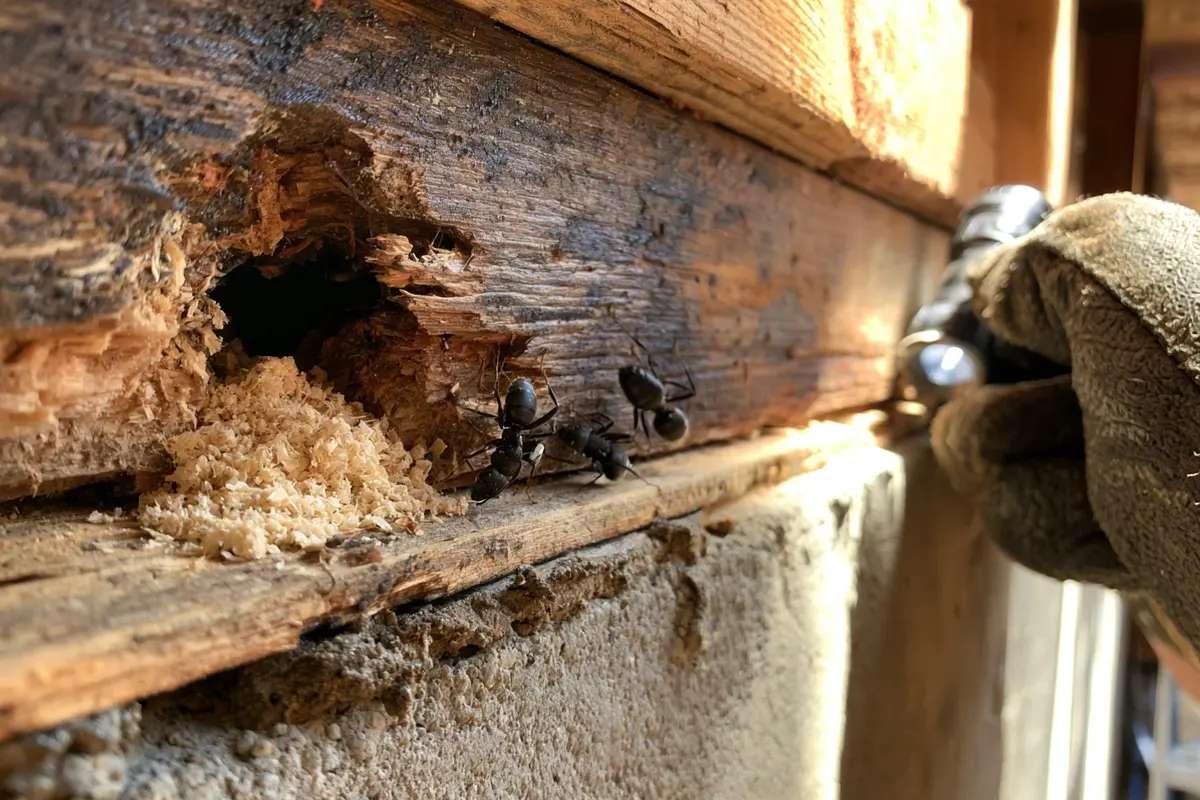
NPIC says carpenter ants leave sawdust-like frass, where termites leave pellets or mud, and the University of Maryland says coarse frass like pencil shavings means a nest is close (NPIC, University of Maryland Extension). IDPH says carpenter ant galleries are smooth and clean, and termite tunnels are lined with mud (IDPH carpenter ants). Termites bring moist mud to seal their tunnels (Illinois Extension), so you may find mud tubes running up a foundation wall. Kentucky Extension says to break open a mud tube to check for live termites, and that an empty tube can still mean past activity (University of Kentucky Entomology).
Check these places first: window sills and door frames, the sill plate where the wood meets the foundation, deck posts and porch steps, the wall near a tub, sink or old leak, and the basement joists. Carpenter ants prefer decayed or water-damaged wood, Colorado State says. Illinois Extension says termites need constant moisture and, in one case it describes, entered through a gap around a drain pipe (Colorado State Extension, University of Illinois Extension).
What each one costs to deal with
Prices below are typical national ranges, not a Rockford quote. See the exterminator cost page for more.
| Job | Typical cost | Source |
|---|---|---|
| Carpenter ant treatment | $250 to $500 per treatment | HomeGuide |
| Termite inspection | $75 to $325 per inspection | HomeGuide |
| Liquid termite barrier, per linear foot | $3 to $20 per linear foot | HomeGuide |
| Whole-home termite bait system | $1,000 to $2,500 per home | HomeGuide |
The gap is the point. A carpenter ant job is aimed at the nest. A termite job is a program: treat the soil around the home, or install bait stations and monitor them. Mississippi State says baits can take several months to control an active infestation and are inspected from quarterly to annually, while liquids are faster with little upkeep but use more chemical (Mississippi State Extension, Mississippi State Extension). EPA says soil-applied barrier treatment is the most common technique, with fipronil and imidacloprid among the common active ingredients, and that bait systems use cellulose bait with a slow-acting insecticide (U.S. EPA). EPA also warns that improper barrier treatments can contaminate the home and nearby drinking water wells, so hire a licensed, trained pest professional.
Why carpenter ants are not a pass on the problem
IDPH says carpenter ants are more nuisance than structural threat, though large colonies can be destructive. Colorado State says the damage develops slowly, which gives time to plan control, and that leaky roofs, clogged gutters and bad flashing invite them. If we find a nest, we also tell you where the moisture is coming from, because NPIC says ventilation and leak repair are part of control (Colorado State Extension, NPIC).
Carpenter ants can also be a satellite problem. IDPH describes a colony as a parent nest outside plus satellite nests, and the satellite is what is usually found inside. Killing indoor satellites may not stop the colony, because the outdoor parent can reinfest, and finding the parent nest is the critical step. That is why treatment starts with a search for the nest, not a spray along the baseboard (IDPH carpenter ants). Colorado State suggests inspecting at night since many species are nocturnal, and Penn State says a stethoscope or an inverted glass on a wall can pick up rustling from a satellite nest (Penn State Extension).
If you are not sure, treat it as termites until proven otherwise
The costs of being wrong are not symmetric. If you assume carpenter ants and it is termites, the colony keeps eating. If you assume termites and it is carpenter ants, you paid for an inspection. Illinois Extension says termite control takes a professional, and that a positive ID should come first because treatment is expensive (Illinois Extension). If you are selling, a buyer using an FHA loan will need the wood destroying insect inspection, and our guide on the termite inspection for a home sale explains it.
We inspect homes in Rockton, South Beloit and Winnebago, along with Rockford. Bring a sample if you have one: a few insects in a sealed bag help.
Sources (19)
- Illinois Department of Public Health, carpenter ants
- University of Illinois, Home, Yard and Garden Pest Newsletter, termites
- University of Illinois Extension, Ask Extension, termite nests and control
- University of Illinois Extension, swarming insects season
- University of Illinois School IPM, subterranean termites
- U.S. EPA, termites: how to identify and control them
- HomeGuide, ant exterminator cost
- HomeGuide, termite inspection cost
- HomeGuide, termite treatment cost
- University of Minnesota Extension, Carpenter Ants
- Colorado State Extension, Carpenter Ants
- Mississippi State Extension, Common Questions About Termites And Termite Control
- National Pesticide Information Center, Carpenterant
- University of Maryland Extension, Carpenter Ants
- Illinois Department of Public Health, Carpenter Ants
- University of Kentucky Entomology, Ef604
- University of Illinois Extension, 2024 07 26 Termite Troubles Three Tips Preventing Infestations
- Mississippi State Extension, P2568 Web
- Penn State Extension, Carpenter Ants
Want a price for your own house?
Call, text, or send the form. You get a price back before any work is scheduled.
Quick answers
Do carpenter ants eat wood like termites?
They do not. IDPH says carpenter ants hollow wood for nests but do not eat it, and are more nuisance than structural threat, though large colonies can be destructive. Termites feed on the wood itself.
How can I tell a carpenter ant from a termite?
Look at the waist and antennae. A carpenter ant has a narrow waist and elbowed antennae. A termite has no pinched waist and straight antennae. If you are unsure, bag one and we will identify it during an inspection.
What season are carpenter ants active in Illinois?
IDPH says carpenter ants are active from spring (March-April) through early fall (September-October).
How much does carpenter ant treatment cost?
One national guide puts it at $250 to $500 per treatment per treatment. That is a typical U.S. range, not a Rockford quote. Termite work costs more, since it is a program and not a single visit. See our exterminator cost page.
Should I spray flying termites I find in my house?
The University of Illinois says swarming termites should be vacuumed rather than sprayed. Swarmers do not bite or damage wood, but their arrival calls for a professional termite inspection.
Can carpenter ants be a sign of a wood rot problem?
Colorado State says carpenter ants prefer decayed or water-damaged wood, so a nest in a wall or sill can point to a leak. We look for the moisture source along with the nest.
Want a price on the job?
Tell us the pest, the town and where you are seeing it. A licensed exterminator replies with a price before any work starts.
Prices and the full service list are on the homepage for a exterminator in Rockford.