
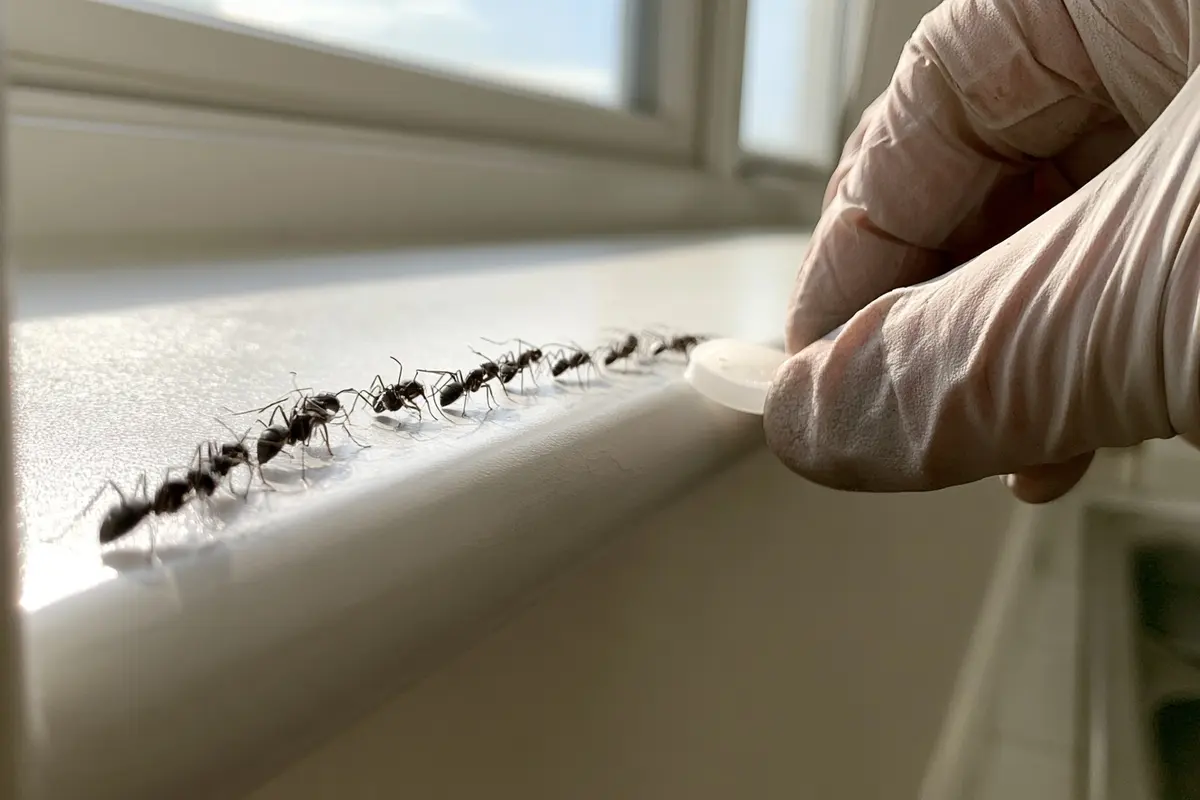
Ant Control in Rockford, IL
Get a free quote
A licensed exterminator replies with a price. Nothing is booked until you say yes.
Updated
Short answer
Most of the ants in a Rockford kitchen are one of two kinds: odorous house ants and pavement ants. The first step is knowing which. Iowa State Extension says the small house-invading ants in the Midwest are mostly pavement ants and odorous house ants (Iowa State Extension). IDPH says the pavement ant is probably the most common ant in structures; often shows up indoors after heavy rain (IDPH, ants), and that crushed odorous house ants smell like rotten coconut. A photo or a few ants in a jar are enough for us to identify them.
The work is done under an Illinois Department of Public Health (IDPH) structural pest control license by a certified technician (IDPH), using EPA-registered products applied according to the label. Rockford Bug Guys starts with the trail and keeps the spray can for last.
What ant control costs in Rockford
These are typical U.S. ranges from national cost guides, not Rockford quotes. Describe your ants through the quote page, and the pest control cost page lists everything else.
| Job | Typical cost | Source |
|---|---|---|
| Ant extermination | $100 to $500 | Angi |
| One-time treatment, 2,000 square foot home | $200 to $300 | HomeGuide |
| Severe infestation, same size home | $800 to $1,200 | HomeGuide |
| Carpenter ant treatment | $250 to $500 per treatment | HomeGuide |
| Quarterly pest plan, per visit | $100 to $300 per visit | Bob Vila |
| Pest plan, per year | $300 to $900 per year | HomeGuide |
The low end is a single trail in one room. The high end is a large home, a colony that is hard to trace, or ants inside the walls. If the ants turn out to be carpenter ants, the job changes, and the price follows.
Why spraying ants rarely works
IDPH says routine spraying of ants and trails rarely cures the problem; baits work better once food is removed (IDPH, ants). Kentucky Extension explains why: spraying visible ants hits a small part of the colony, while typically thousands of ants and one or more queens stay hidden in the nest (Kentucky Extension). Minnesota Extension says spraying helps only temporarily with seasonal ants and has little effect on the nest (UMN Extension). Bait works the other way. Iowa State says bait is food plus a slow poison that workers carry to the queen, and the whole colony can die (Iowa State Extension). North Carolina State puts it plainly: baits can kill the colony while a surface spray kills only the workers it touches (NC State).
How long ant bait takes, and what not to do
Be ready for weeks. UMN says baits can take weeks to months to clear a colony, and an odorous house ant extension fact sheet says to expect two or more weeks before the population drops noticeably (UMN Extension and odorous house ant fact sheet). Activity can even rise at first, because more workers are recruited to the bait (Odorous house ant guidance). That rise is the bait working, so do not panic and spray. UMN also says spraying near bait ruins it, because workers stop carrying it home. Wipe up crumbs and spills, and let the bait do its work.
Nonrepellent or repellent: why the type of product matters
Utah State Extension says nonrepellent products do not scatter ants, because the ants cannot detect them. Workers track the chemical back to the nest and spread it around the colony. A repellent perimeter product can instead cut indoor ants off from the colony and create new indoor problems (Utah State Extension). That finding is documented for ants only, so we do not generalize it to other pests. Odorous house ants add one more wrinkle: they form networks of many nests, so treating one nest may not finish the job (Odorous house ant guidance). It is one reason follow-up visits are normal for them.
| Approach | What it does | When it fits |
|---|---|---|
| Bait | Slow-acting food that workers carry back to the colony | Trails in the kitchen and bath, especially sweet-loving ants |
| Exterior barrier | A labeled product applied around the foundation, door frames and window frames | Ants coming in from outside |
| Spot treatment | A labeled product applied where a nest or entry point is found | A nest in a wall void, under a slab or in a yard |
| Sanitation and sealing | Clean up food, fix leaks, seal cracks | Always. It makes the rest work |
We tell you to leave the trail alone before we come, because it shows us where they go. Wipe up crumbs and sticky spots and store food in sealed containers, and skip the spray.
Odorous house ants
IDPH says crushed odorous house ants smell like rotten coconut, which is the most useful clue for telling them from other small kitchen ants (IDPH, ants). They form networks of many nests, so one trail can lead back to more than one colony. Indoor bait and an exterior treatment together are how we approach them. A leak under the sink is a reason to fix the leak as well as call us.
Pavement ants
IDPH calls the pavement ant probably the most common ant in structures, and says it often shows up indoors after heavy rain (IDPH, ants). If your ants appear after a storm, look at the foundation and slab edges first. We bait indoors and treat the foundation outdoors.
Is it a carpenter ant?
Carpenter ants are larger, and they come for a nest site and leave the food alone. IDPH says carpenter ants hollow wood for nests but do not eat it, and are more nuisance than structural threat, and that the season runs spring (March-April) through early fall (September-October) (IDPH, carpenter ants). Large ants and sawdust-like debris near wood are the clues, and they often point to wet or damaged wood. See the carpenter ant treatment page and the carpenter ants vs termites guide. Winged ants can also be termite swarmers, and the termite treatment page covers that case.
One-time treatment or a pest plan
A one-time visit suits one problem in one season. A plan suits a house with ants, spiders and the usual fall invaders every year. A national guide puts a quarterly plan at $100 to $300 per visit and a year at $300 to $900 per year, with the first visit costing more at $150 to $300 per initial visit (Bob Vila and HomeGuide). The quarterly pest control guide compares the numbers, and we say so when one visit is enough.
What the first month looks like
Week one, you will probably see more ants at the bait than before, because more workers are recruited to it. That is normal, and extension guidance says to expect it (odorous house ant guidance). By two weeks the population should start to drop noticeably, according to the odorous house ant fact sheet. A network of nests may need a second round of bait or an exterior treatment. UMN says the full job can take weeks to months, so we plan for that range and do not promise a day. If the trail is still strong at the follow-up, tell us where you see it.
Through all of it, leave the spray can in the cupboard. UMN says spraying near bait ruins it. Wipe the counters, keep the food sealed and let the workers do the work for you.
What we need to know before the visit
| Question | Why we ask |
|---|---|
| Where did you see them, and at what time of day? | Trails near food and water point to the nest and the species |
| Do the ants come in after rain? | Points toward pavement ants and a slab or foundation entry |
| Do they smell like coconut when crushed? | A clue that they are odorous house ants |
| Are they large, with sawdust nearby? | Points to carpenter ants and a moisture problem |
| Any pets or small children? | We plan bait placement around them |
| Any leaks, or wood touching soil? | Moisture draws carpenter ants and feeds other colonies |
Which ant is it: a quick guide
| Clue | Likely ant | Next step |
|---|---|---|
| Small, dark ants on kitchen counters that smell like rotten coconut when crushed | Odorous house ant | Bait indoors, treat the foundation outside |
| Ants after a heavy rain | Pavement ant, which IDPH says often shows up indoors after heavy rain | Bait indoors, treat the foundation and slab edge |
| Large ants with wood debris near damaged or wet wood | Carpenter ant, which hollows wood for nests but does not eat it | Find the nest and the moisture source |
| Winged ants indoors | A swarm of ants or termites. Termites have straight antennae and no pinched waist | Look at the antennae and waist, or call for an inspection |
| Ants trailing to a pet bowl or a sweet spill | A foraging trail from a nest nearby | Leave the trail alone and bait it |
A trail that disappears into a wall, a window frame or a crack in the foundation shows you where the entry point is. Take a photo and note the time of day. We use both to pick the bait.
Common Illinois house ants at a glance
| Ant | What the sources say | What it means for treatment |
|---|---|---|
| Odorous house ant | Smells like rotten coconut when crushed (IDPH). Forms networks of many nests (odorous house ant guidance) | Bait works, and one nest treated may not end it, so we plan a follow-up |
| Pavement ant | Probably the most common ant in structures, often indoors after heavy rain (IDPH) | Bait indoors, and look at the foundation and slab edges |
| Carpenter ant | Hollows wood for nests but does not eat it, and is more nuisance than structural threat (IDPH). The season runs March-April through September-October | A different job. Find the nest and the moisture source |
Sources: IDPH, ants, IDPH, carpenter ants and odorous house ant guidance.
What an ant visit looks like
| Step | What happens |
|---|---|
| Identify | We look at the ant, where the trail runs and when they show up, then pick the product |
| Bait | Slow-acting bait goes where workers will find it and carry it to the colony. We ask you to leave the trail alone |
| Exterior | A labeled treatment at the foundation and entry points when ants are coming in from outside. We choose repellent or nonrepellent with the colony in mind |
| Wait | Expect weeks, not a day. Activity may rise first while workers recruit to the bait |
| Follow up | We check the bait and the trail and refresh it. A network of nests may need another round |
Keep your own steps simple while bait is working. Keep wiping counters, store sweets and pet food in sealed containers, fix drips and do not spray near the bait. Hort-extension guidance says to seal gaps because foragers find crumbs and sugar (Home and Landscape Extension). Sealing the cracks you can see on the trail helps, and we point out the ones that need a repair.
Keeping ants out of the kitchen
Ants come for food and water. Wipe counters and the stove every night, keep sweets, pet food and honey in sealed containers, rinse recycling before it goes in the bin and take the trash out. Fix a dripping faucet or a leak under the sink. Extension advice is to seal gaps and keep food in sealed containers, since foragers find crumbs and sugar (Home and Landscape Extension). These habits do not replace bait, and they make the bait work faster.
Why we treat the nest, not just the trail
A trail is the part of the colony that happens to be visible. Kentucky Extension says the typical colony hides thousands of ants and one or more queens, so killing foragers at the counter leaves the source untouched. North Carolina State says surface sprays kill only the workers they touch. That is the reason the plan above leans on bait, a nonrepellent exterior treatment where it fits, and patience. If you remember one thing from this page, make it this: the ants you see are not the ants you need to kill.
Questions to ask any ant exterminator
Is the company licensed by IDPH, and is a certified technician doing the treatment? Do they identify the ant before they pick a product? Is the quote for bait, an exterior barrier or both? How many visits are included? What should you do and avoid before they come? Ask what the guarantee covers, in writing, since a promise that is only spoken is not one you can use. The license check guide shows how to confirm the license.
We treat ants in Rockford and in Loves Park, Roscoe, Rockton and Byron. If you see ants and wood damage, call about termite treatment too, and if mice are in the picture, see mouse and rat control. The FAQ page answers scheduling questions.
Sources (16)
- Iowa State Extension, Ant Baits Small Household Ants
- University of Kentucky Entomology, Ef619
- University of Minnesota Extension, Ants
- NC State Extension, Tips For Effective Ant Baiting
- Washington State University Extension, Odorous House Ant
- University of Wisconsin Extension, Odorous House Ants
- Utah State Extension, Pavement Ants
- University of Nebraska-Lincoln Entomology, Ants
- Angi, pest control service cost
- HomeGuide, pest control prices
- Bob Vila, pest control cost
- HomeGuide, ant exterminator cost
- Illinois Department of Public Health, ants
- Illinois Department of Public Health, carpenter ants
- Illinois Department of Public Health, Structural Pest Control
- University of Illinois Extension, swarming insects season
Where this is done
Ant Control across Rockford and the cities and villages around it. Each town page covers that town's own housing age, property rules and mosquito program; the full list is on the service area page.
Ready for a price on ant control?
Call, text, or send the form. You get a price back before any work is scheduled.
Ant Control: questions
How much does ant extermination cost in Rockford?
A national guide puts ant extermination at $100 to $500. That is a typical U.S. range, not a Rockford quote. See the pest control cost page.
Why do I see ants after it rains?
IDPH says the pavement ant is probably the most common ant in structures; often shows up indoors after heavy rain. Look at the foundation and slab edges.
Why does spraying not stop the ants?
IDPH says routine spraying of ants and trails rarely cures the problem; baits work better once food is removed. The spray kills the ants you see, and the colony keeps sending more.
How do I tell odorous house ants from carpenter ants?
IDPH says crushed odorous house ants smell like rotten coconut. Carpenter ants are larger and hollow wood for nests. See the carpenter ant treatment page and the carpenter ants vs termites guide.
Do carpenter ants eat the wood?
IDPH says carpenter ants hollow wood for nests but do not eat it, and are more nuisance than structural threat. They often point to a moisture problem.
Is a pest plan worth it for ants?
One national guide puts a quarterly visit at $100 to $300 per visit. A plan fits houses with repeat problems. See the quarterly pest control guide.
How long does ant bait take to work?
UMN Extension says baits can take weeks to months to clear a colony, and an odorous house ant fact sheet says to expect two or more weeks before the population drops noticeably. Activity can rise at first as more workers are recruited to the bait.
Why can't I spray near the ant bait?
UMN Extension says spraying near bait ruins it, because workers stop carrying it home to the colony.
What is a nonrepellent ant treatment?
Utah State Extension says ants cannot detect nonrepellent products, so workers carry them back to the nest and spread them around the colony. Repellent perimeter products can cut indoor ants off from the colony and create new indoor problems.
Should I spray the trail before you come?
Leave the trail alone. It shows us where they go, and baits work better when the ants keep feeding.
What if the winged ants are termites?
Illinois Extension says finding winged termites indoors or outdoors is a red flag that the home should be inspected. See the termite treatment page and the swarmers guide.
Related guides
Other services
Ant Control: get a written price
Tell us the pest, the town and where you are seeing it. A licensed exterminator replies with a price, and no work starts until you agree to it.
Prices and the full service list are on the homepage for a exterminator in Rockford.