
Bees vs Wasps: Who to Call for a Nest
Updated
Short answer
Part of Wasp Nest Removal.
Get a free quote
A licensed exterminator replies with a price. Nothing is booked until you say yes.
There is a cluster of insects on the fence post, or a stream of them going in and out of a gap in the siding. Before you call anyone, you need to know if it is bees or wasps, because the right person is different. We handle wasps, hornets and yellowjackets, covered on our wasp nest removal page. We do not remove honey bees. This page explains the difference and who to call.
How to tell a honey bee from a wasp
We could not find an Illinois source that describes the body of a honey bee against a wasp, so we lean on what the sources do say: where the nest is and how the insect behaves. IDPH says yellowjackets scavenge at trash containers and picnics in late summer (IDPH bees and wasps). Illinois Extension says yellowjackets nest in abandoned rodent holes in the soil and in building voids, cracks and crevices, and that the bald-faced hornet builds a large nest, usually in a tree canopy (Illinois Extension). A swarm hanging in a ball on a branch or fence in spring is a different situation, and IDPH describes spring honey bee swarms as in transit. When you cannot tell, a photo from a distance is the quickest answer.
| Insect | How to tell | Who to call |
|---|---|---|
| Honey bee | A spring swarm in a ball on a branch or fence, or a colony in a wall | Registered beekeeper |
| Yellowjacket | At trash cans and picnics in late summer, nest in the ground or a wall void | A pest company (us) |
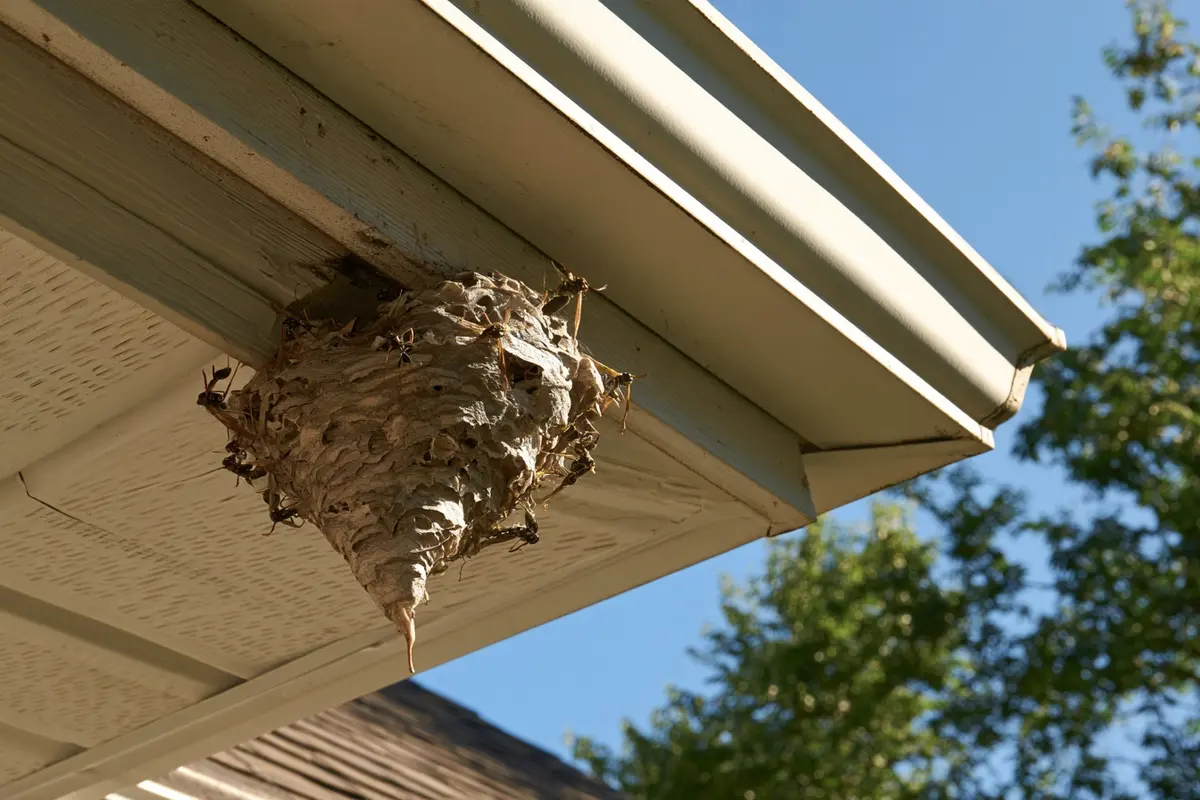
| Paper wasp | A nest under an eave, railing or porch ceiling | A pest company (us) |
| Bald-faced hornet | A large nest, usually in a tree canopy | A pest company (us) |
Honey bee swarms: leave them alone if you can
IDPH says honey bee swarms in spring are in transit and usually leave within two to four days, so they should be tolerated if possible (IDPH bees and wasps). A swarm hanging on a bush is passing through.
If the swarm stays, or lands where people walk, a beekeeper is the right call. Honey bees are an asset, and a beekeeper can take the swarm and keep the colony alive. National guides put honey bee swarm removal at $125 to $200 per swarm, and one notes it is sometimes free if a nearby beekeeper can reach the swarm easily (HomeGuide). That is a typical U.S. range from one guide, not a Rockford quote.
Why we send honey bees to a beekeeper
Illinois law requires beekeepers to register their honeybee colonies, even one colony, with the Illinois Department of Agriculture, and the Department inspects honeybee colonies for health at no charge to beekeepers (Illinois Department of Agriculture). Those beekeepers are the people whose business is moving bees to a hive. A pest company kills what it is hired to kill. If the problem is honey bees, we would rather you get them rehomed.
To find one, start with the Illinois Department of Agriculture page on bees and apiaries listed in our sources, and ask at a local feed store or a county Extension office. Ask whether they do swarm calls and whether they charge.
When bees are inside a wall
A swarm on a branch is easy. A colony that has already moved into a wall or an attic is harder, and taking it out may mean opening the wall. A beekeeper who does cutouts, or a contractor working with one, handles that. Call a beekeeper first. If they will not take the job, tell us what you have and we will tell you honestly whether it is bees, in which case we will say so, or wasps.
When it is wasps, hornets or yellowjackets
Then it is our job. IDPH says yellowjacket numbers peak in late summer (IDPH), and they are often in the ground or in a wall void. Our guide on yellowjackets in late summer covers where the nests are. Nest removal runs $300 to $700 per nest per nest nationally (HomeGuide, Angi), a typical range and not a quote. See the exterminator cost page.
IDPH reports that 50 to 100 people die each year from bee and wasp stings, and about 1 percent of the population is allergic to the venom (IDPH). If anyone in your household has had a serious reaction to a sting, keep them away from the nest until it is handled.
If it is wasps: what the treatment looks like
Extension sources say to treat a wasp nest at night, after the workers have returned to it, and that a red-covered flashlight is better than white light, which attracts wasps (Virginia Tech Extension, Purdue Extension). Iowa State says not to plug a wall opening until the activity has fully stopped (Iowa State Extension). Purdue says nests above ground and nests inside structures are best left to professionals. That is the line between a bee call and a wasp call: if it is a honey bee swarm, wait or call a beekeeper, and if it is a wasp nest near a door or a play area, call us and we treat it at dusk.
Wasp colonies do not carry over. Iowa State says workers die at the first freezes and only fertilized queens overwinter, and Virginia Tech says old nests are not reused (Iowa State Extension, Virginia Tech Extension).
What to do right now
- Stay back and keep children and pets away from the area.
- Take a photo from a distance. It helps whoever you call tell the insect.
- Watch for two to four days if it is a spring swarm on a branch. It may leave on its own.
- If the insects are going in and out of one hole, note where, and whether it is in the ground or a wall.
- Do not spray bees with a household insecticide before a beekeeper looks. It kills the colony the beekeeper could have saved.
We take wasp calls in Loves Park, Roscoe and Pecatonica, along with Rockford. If you are not sure what you have, send us a photo and we will tell you who to call.
Sources (10)
- Illinois Department of Public Health, bees and wasps
- Illinois Department of Agriculture, bees and apiaries
- Illinois Extension, yellow jackets and hornets
- Illinois DNR, Wild About Wasps, bald-faced hornet
- HomeGuide, bee removal cost
- HomeGuide, wasp and hornet nest removal cost
- Angi, wasp removal cost
- Virginia Tech Extension, ENTO 49
- Purdue Extension Entomology, E-44
- Iowa State Extension, Social Wasps
Want a price for your own house?
Call, text, or send the form. You get a price back before any work is scheduled.
Quick answers
Who removes honey bees in Illinois?
A beekeeper does. Illinois requires beekeepers to register their honeybee colonies with the Illinois Department of Agriculture. A pest company is not the right call for honey bees, which is why we send swarms to a beekeeper.
How long does a bee swarm stay?
IDPH says spring honey bee swarms are in transit and usually leave within two to four days, so they should be tolerated if possible. If one stays longer or lands where people walk, call a beekeeper.
How much does bee swarm removal cost?
One national guide puts honey bee swarm removal at $125 to $200 per swarm, and notes it is sometimes free when a nearby beekeeper can easily reach the swarm. That is a typical U.S. range, not a Rockford quote.
Does your company remove bees?
We do not. We remove wasps, hornets and yellowjackets. For a honey bee swarm, see our wasp nest removal page for what we handle and call a registered beekeeper for the bees.
What is the difference between a bee and a wasp?
We did not find an Illinois source that describes their bodies, so we go by behavior and nests. Yellowjackets scavenge at trash cans and picnics in late summer, per IDPH, and spring honey bee swarms are in transit and usually leave within two to four days. Send a photo and we will tell you who to call.
Is a bald-faced hornet a bee or a wasp?
It is a wasp. Illinois Extension says it builds a large nest, usually in a tree canopy. That is a job for us, not a beekeeper. IDNR lists it as common and native in Illinois.
Want a price on the job?
Tell us the pest, the town and where you are seeing it. A licensed exterminator replies with a price before any work starts.
Prices and the full service list are on the homepage for a exterminator in Rockford.