
Spiders in a Rockford Basement: What to Know
Get a free quote
A licensed exterminator replies with a price. Nothing is booked until you say yes.
You went down to move the laundry and a large spider shot across the floor. Or there are webs in every corner of the ceiling joists and a few dead ones along the wall. Basements are where spiders show up, and most of the time they are not the ones people fear. This page explains what is probably down there, what the Illinois sources say about the dangerous kinds, and what we do about it. Our spider control page covers the service.
What kind of spider is it?
IDPH says Illinois has more than 500 different kinds of spiders living in a variety of habitats (IDPH spiders). Only a few of them are likely to be in your basement, and the big, fast, hairy ones are the ones that scare people most.
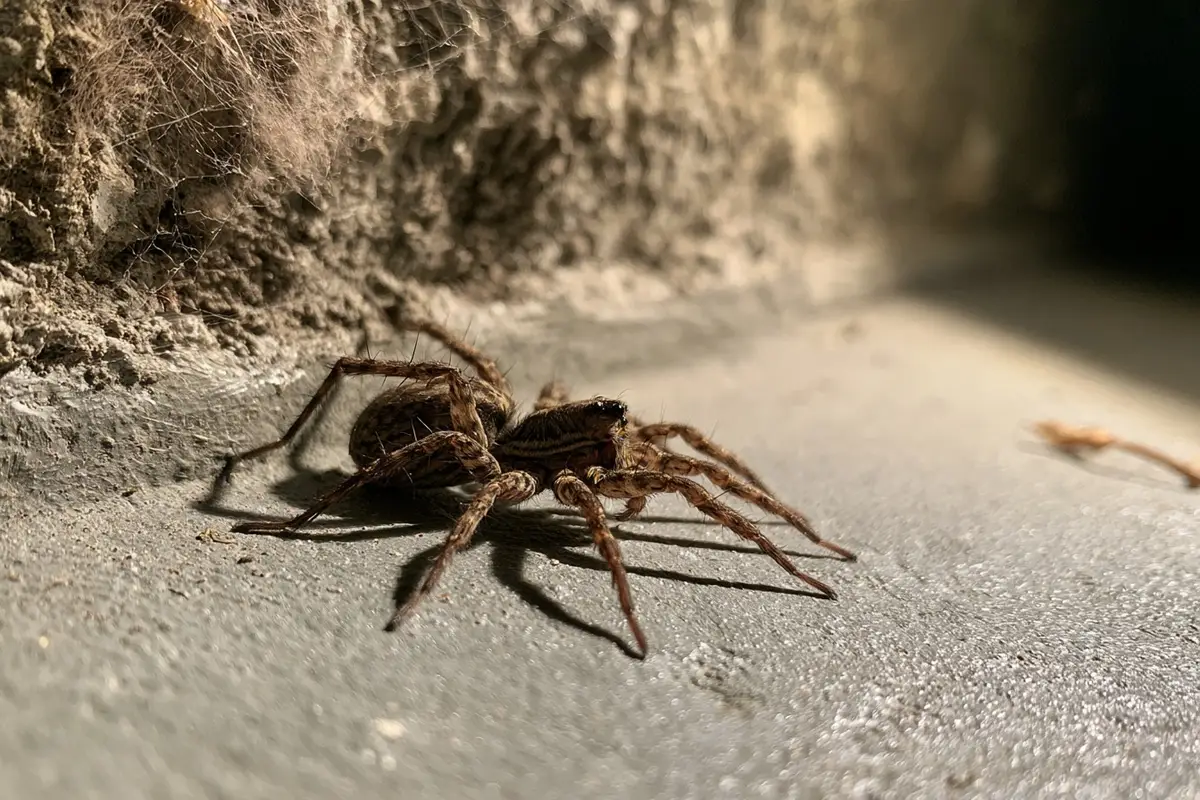
IDPH says any large hairy spider in the eastern half of the United States is more than likely a wolf spider, and that its bite is not considered dangerous. Wolf spiders hunt on the ground and do not spin a web to catch prey, which is why you see them running across a floor and not sitting in a web. A basement near a door, window well or crawl space gives them a way in and plenty of places to hide.
The webs in the corners belong to spiders that build instead of hunt, and IDPH says web builders are easier to control than hunters (IDPH spiders). Webs mean prey, so a lot of webs usually means a lot of small insects for them to eat.
What about brown recluse and black widow?
This is the question we get most, and we will answer it only as far as the sources go. The Illinois Department of Natural Resources says the brown recluse may be found in the the southern two-thirds of Illinois, and lists it as common and native there (Illinois DNR). Rockford is in the far northern part of the state, and that statement does not say whether one has ever been found in Winnebago County. No source we found says either way, so we are not going to guess. IDPH has a separate page on the brown recluse and black widow (IDPH).
The practical advice is simple. Do not assume a spider is a brown recluse because someone said so. If you want it identified, IDPH identifies insects and other arthropods that residents mail in with its Arthropod Specimen Form (IDPH FAQ), and we can look at one during a visit. If you get a bite that worsens or a wound that does not heal, see a doctor and bring the spider if you have it.
| Spider | What sources say |
|---|---|
| Wolf spider | Large and hairy, bite not considered dangerous (IDPH) |
| Web builders | Easier to control than hunting spiders (IDPH) |
| Brown recluse | IDNR: may be found in the the southern two-thirds of Illinois; county presence not stated |
Why spiders choose a basement
Colorado State says pesticides alone fail unless you also remove habitat and seal gaps, and Mississippi State calls exclusion and sanitation the main steps (Colorado State Extension, Mississippi State Extension). A basement offers boxes, stored furniture, prey and gaps. Less clutter takes away hiding places. Fewer insects take away food. Sealing gaps around pipes, the rim joist and window wells takes away access. IDPH adds that funnel web and sac spiders enter structures in fall, and that outside lighting draws insects and so spiders (IDPH spiders). The median Rockford home was built in 1965, so gaps at the foundation and around old windows are worth checking (Census ACS 2024).
What helps, in order
- Move boxes off the floor onto shelves, and swap cardboard for plastic bins.
- Vacuum spiders, webs and egg sacs. IDPH calls vacuuming a non-toxic method.
- Seal gaps where pipes, wires and vents enter, and fix torn window well covers.
- Cut back outdoor lighting near the foundation where you can, since lights draw the insects spiders eat.
- Shake out shoes and stored boxes before you reach in. The University of Illinois says bites happen when a spider is pressed against skin, like in shoes or boxes (University of Illinois Division of Research Safety).
A treatment adds a layer. We apply EPA-registered products along the foundation, window wells and the basement edges, under an Illinois Department of Public Health structural pest control license, following the label. It is aimed at the insects spiders feed on as well as the spiders. Texas A&M School IPM says insecticide sprays usually do little against spiders beyond some repellency (Texas A&M School IPM), so we treat the spray as a supporting step and put the weight on vacuuming, sealing and cutting down the insects.
Webs, egg sacs and what to clean
A treatment does not remove old webs. Knock down webs with a vacuum hose or a broom so you can tell what is new, and vacuum any egg sacs you find. Do the same around window wells, behind the water heater and along the top of the foundation wall, where the sill plate meets the concrete.
If you see a spider in the house, the most useful thing you can do is catch it in a jar for identification. A photo from above with something for scale, like a coin, is the next best thing. Do not handle spiders with bare hands.
What spider control costs
National guides put spider control at $100 to $500 (Angi, HomeGuide). The price depends on house size, how many spiders you have and whether it is a one-time visit or a plan. These are typical U.S. ranges, not a Rockford quote. See the exterminator cost page. If spiders come back every year, a plan may cost less than repeat calls, and our guide to quarterly pest control covers when that is true.
Spiders and other basement pests
A lot of spiders usually means a lot of small insects for them to eat. If you also see roaches, the spider is not the root problem. Read our guides on German cockroaches and mice in the house in fall for what to check. We cover Belvidere, South Beloit and Rockton, where older basements are common.
Sources (11)
- Illinois Department of Public Health, spiders
- Illinois DNR, Wild About Spiders, brown recluse
- Illinois Department of Public Health, brown recluse and black widow spiders
- Illinois Department of Public Health, Structural Pest Control FAQ
- Angi, pest control service cost
- HomeGuide, pest control prices
- U.S. Census Bureau, ACS 2024 1-year, tables B25034 and B25035 (via Census Reporter)
- Colorado State Extension, Spiders In The Home
- Mississippi State Extension, P2443 Web
- Texas A&M School IPM, Ipm Action Plan For Spiders
- University of Illinois Division of Research Safety, Arachnids
Want a price for your own house?
Call, text, or send the form. You get a price back before any work is scheduled.
Quick answers
Are basement spiders dangerous?
Most are not. IDPH says any large hairy spider in the eastern U.S. is most likely a wolf spider, and its bite is not considered dangerous. If you are bitten and the wound worsens or does not heal, see a doctor.
Are there brown recluse spiders in Rockford?
The Illinois DNR says the brown recluse may be found in the southern two-thirds of Illinois. No source we found states whether one has been found in Winnebago County, so we do not say either way. IDPH will identify a specimen you mail in.
How much does spider control cost?
National guides put spider control at $100 to $500. That is a typical U.S. range, not a Rockford quote. See our exterminator cost page.
Why do I have so many spiders in my basement?
Spiders go where hiding places, prey and a way in come together. Colorado State says pesticides alone fail unless you also remove habitat and seal gaps. Fewer insects and fewer hiding places mean fewer spiders.
Does spraying get rid of spiders?
Texas A&M School IPM says insecticide sprays usually do little against spiders beyond some repellency. Vacuuming, sealing gaps and removing clutter and prey do more, so we treat spray as a supporting step.
How many kinds of spiders are in Illinois?
IDPH says there are more than 500 kinds of spiders in Illinois. Only a few are common inside houses.
Want a price on the job?
Tell us the pest, the town and where you are seeing it. A licensed exterminator replies with a price before any work starts.
Prices and the full service list are on the homepage for a exterminator in Rockford.